


- October 28 2026
- Nikias Kray
SEO vs GEO: How Work Together
The debate around SEO vs GEO has moved from conference stages into everyday marketing meetings. For more than two decades, search engine optimization (SEO) has been the main way businesses earned visibility on Google, Bing and other search engines. Today, a growing share of users ask questions directly to AI assistants and answer engines such as ChatGPT, Google Gemini, Microsoft Copilot, Perplexity and Google AI Overviews. These systems do not simply list ten blue links; they generate a synthesized answer and, in many cases, cite a handful of sources. Optimizing for that new environment is called generative engine optimization (GEO).
This article explains the difference between SEO and GEO, where they overlap, which signals matter for each discipline, and how to build a practical strategy that protects your organic traffic while increasing your chances of being cited by AI-generated answers. If you run a B2B company, a SaaS product or a CRM-focused business, understanding SEO vs GEO is no longer optional: it directly affects how prospects discover, evaluate and shortlist vendors.
Key Takeaways
- SEO aims to rank pages in traditional search results; GEO aims to have your brand and content quoted, cited or recommended inside AI-generated answers.
- GEO does not replace SEO. Most generative engines rely on web indexes, so solid technical SEO remains the foundation of GEO.
- GEO rewards clear definitions, factual density, structured content, original data, expert authorship and consistent brand mentions across the web.
- Success metrics differ: SEO tracks rankings, clicks and organic sessions, while GEO tracks citations, brand mentions, share of voice in AI answers and assisted conversions.
- The most resilient strategy combines both disciplines in a single content and technical roadmap.
What Is SEO?
Search engine optimization is the practice of improving a website so that it ranks higher in organic search results for relevant queries. Classic SEO is usually divided into three pillars. Technical SEO ensures that search engines can crawl, render and index pages efficiently: site architecture, page speed, Core Web Vitals, mobile friendliness, canonical tags, XML sitemaps, robots directives and structured data. On-page SEO covers keyword targeting, title tags, meta descriptions, headings, internal linking and content quality. Off-page SEO focuses on authority signals, primarily backlinks, brand mentions and digital PR.
The output of SEO is a ranking position on a search engine results page (SERP). A user sees your title and snippet, clicks, and lands on your website. Every element of the classic funnel, from impressions to clicks to conversions, can be measured in tools such as Google Search Console and web analytics platforms.
What Is GEO?
Generative engine optimization is the practice of structuring and distributing content so that large language model (LLM) based systems are more likely to retrieve it, understand it, trust it and reference it when they generate answers. The term was popularized by academic research in 2023 that tested how different content changes, such as adding citations, quotations and statistics, influenced visibility in generative search responses.
In GEO, the "result" is not a position on a page but an inclusion in an answer. Your brand might be named as a recommended vendor, your definition might be paraphrased, or your page might appear as a cited source with a link. Sometimes the user never clicks at all, yet the brand impression still shapes their decision. This is why GEO is closely related to brand building and reputation management, not only to traffic acquisition.
SEO vs GEO: The Core Differences
The simplest way to frame SEO vs GEO is this: SEO helps search engines find and rank your pages, while GEO helps AI systems understand and quote your expertise. Both disciplines share the same raw material, which is high-quality, accessible content, but they reward it differently.
Traditional search engines evaluate hundreds of ranking factors to order documents. Generative engines typically retrieve a set of relevant passages, often through a search index, and then a language model composes an answer. In that process, passages that are self-contained, clearly worded, factually specific and attributable are easier to use. A long, vague introduction that ranks well might be ignored by an AI answer, while a concise definition paragraph buried halfway down a page might be quoted verbatim.
Side-by-Side Comparison: SEO vs GEO
Primary goal
- SEO (Search Engine Optimization): Rank pages in organic search results
- GEO (Generative Engine Optimization): Be cited or recommended in AI-generated answers
Main platforms
- SEO (Search Engine Optimization): Google Search, Bing, Yandex, other search engines
- GEO (Generative Engine Optimization): ChatGPT, Gemini, Copilot, Perplexity, Google AI Overviews
Unit of optimization
- SEO (Search Engine Optimization): Whole page and its keyword targeting
- GEO (Generative Engine Optimization): Individual passages, facts, definitions and entities
Key signals
- SEO (Search Engine Optimization): Relevance, backlinks, technical health, user experience
- GEO (Generative Engine Optimization): Clarity, factual density, authority, citations, brand consensus
Content format
- SEO (Search Engine Optimization): Keyword-focused pages, long-form guides, landing pages
- GEO (Generative Engine Optimization): Answer-first structure, FAQs, lists, tables, original data
Success metrics
- SEO (Search Engine Optimization): Rankings, impressions, CTR, organic sessions
- GEO (Generative Engine Optimization): Citations, brand mentions, AI share of voice, referral traffic
Measurement maturity
- SEO (Search Engine Optimization): Mature tools and standard reporting
- GEO (Generative Engine Optimization): Emerging tools, partly manual prompt testing
Time to impact
- SEO (Search Engine Optimization): Weeks to months
- GEO (Generative Engine Optimization): Depends on index refreshes and model updates
Role of brand
- SEO (Search Engine Optimization): Supporting signal
- GEO (Generative Engine Optimization): Central signal: models repeat widely shared brand associations
Where SEO and GEO Overlap
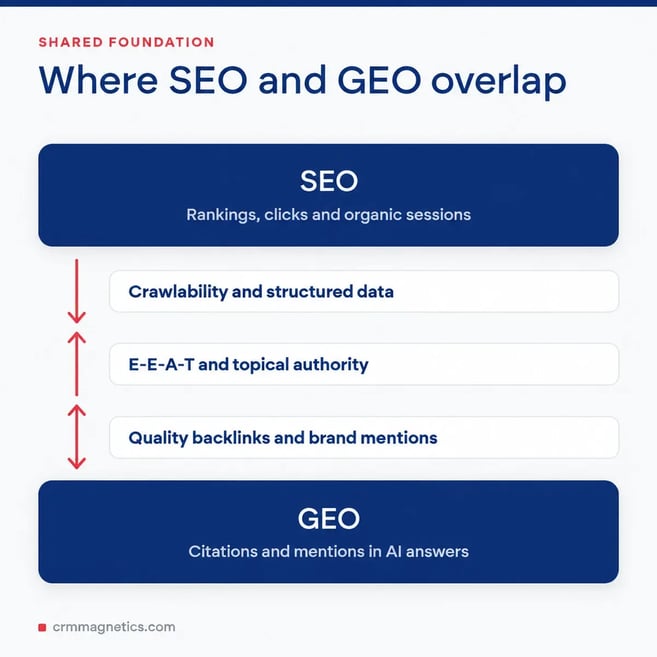
It is tempting to treat GEO as a completely new channel, but in practice the overlap is large. Many AI answer engines use live web search to ground their responses. If your page is not indexed, loads slowly, is blocked by robots rules or lacks topical authority, it is unlikely to be retrieved in the first place. Here are the areas where both disciplines reinforce each other:
- Crawlability and indexation. Clean HTML, server-side rendered content and logical URL structures help both search crawlers and AI retrieval systems.
- E-E-A-T signals. Experience, expertise, authoritativeness and trustworthiness matter for Google rankings and also make content safer for AI systems to cite.
- Structured data. Schema.org markup for Organization, Article, FAQPage, Product and HowTo clarifies entities and relationships.
- Topical authority. Covering a subject in depth through content clusters signals expertise to both ranking algorithms and language models.
- Quality backlinks and mentions. Links drive SEO authority, while unlinked brand mentions on reputable sites help models associate your brand with specific topics.
GEO-Specific Optimization Techniques
While the foundation is shared, several techniques are particularly valuable for generative engines.
1. Write Answer-First Content
Start each section with a direct, one- or two-sentence answer to the question implied by the heading. Then expand with context, examples and nuance. This pattern mirrors how AI systems extract passages and makes your content easy to quote.
2. Use Clear Definitions and Entities
Define key terms explicitly: "Predictive analytics in CRM is the use of historical customer data and statistical models to forecast future outcomes such as churn or deal closure." Consistent terminology helps models connect your brand to the concept.
3. Increase Factual Density
Content that includes specific facts, verified statistics, named sources, dates and concrete examples tends to be more useful for generative answers than generic marketing copy. Always cite the original source and avoid unverifiable claims; accuracy is a trust signal.
4. Structure Content for Extraction
Use descriptive H2 and H3 headings, bulleted lists, numbered steps, comparison tables and FAQ blocks. Each block should make sense on its own, without depending on the surrounding paragraphs.
5. Publish Original Research and Data
Surveys, benchmarks, case studies and proprietary datasets give AI systems something unique to reference. When many sites cite your data, models learn to associate your brand with that topic.
6. Build Brand Consensus Across the Web
Generative models summarize what the web broadly agrees on. Consistent descriptions of your company on your website, review platforms, industry directories, partner pages, podcasts and media articles increase the likelihood that AI assistants describe you accurately and recommend you in relevant contexts.
7. Keep Content Fresh
Many AI answer engines favor up-to-date sources, especially for fast-moving topics such as software, pricing and regulations. Display clear publication and update dates and refresh key pages regularly.
How to Measure SEO and GEO Performance
SEO measurement is well established: keyword rankings, impressions, click-through rate, organic sessions, conversions and revenue attributed to organic search. GEO measurement is still evolving, but a practical framework includes the following:
- Prompt tracking. Build a list of 30 to 100 prompts your buyers are likely to ask, such as "best B2B CRM solutions for mid-sized manufacturers", and check regularly whether your brand appears in the answers across several AI platforms.
- Citation monitoring. Record which of your URLs are cited as sources and which competitors appear alongside you.
- AI referral traffic. Segment analytics traffic from domains such as chatgpt.com, perplexity.ai, gemini.google.com and copilot.microsoft.com.
- Branded search lift. Growth in branded queries can indicate that users discovered you through AI answers and then searched for you directly.
- Sentiment and accuracy. Check whether AI systems describe your products, pricing and positioning correctly, and correct inaccurate public information at the source.
Building a Combined SEO and GEO Strategy
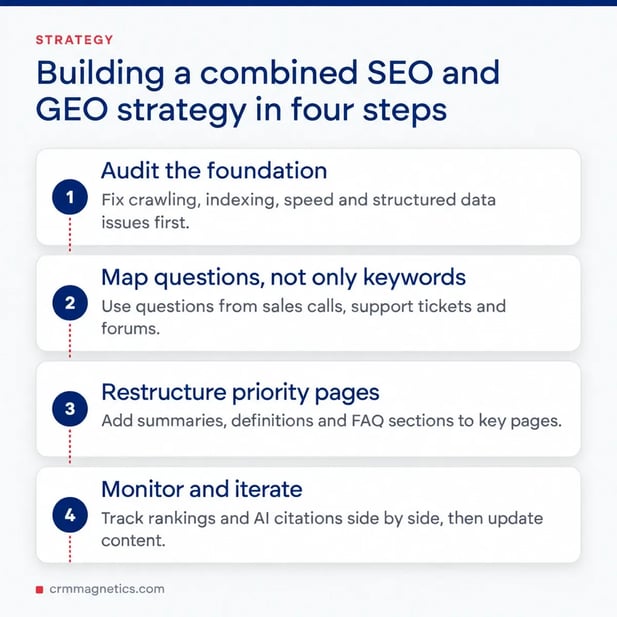
The best results come from treating SEO vs GEO not as a choice but as two lenses on the same content program. A practical roadmap looks like this:
- Audit the foundation. Run a technical SEO audit to fix crawling, indexing, speed and structured data issues. Without this, GEO efforts will be limited.
- Map questions, not only keywords. Combine keyword research with conversational query research: questions from sales calls, support tickets, community forums and "People also ask" boxes.
- Restructure priority pages. Add summary blocks, definitions, comparison tables and FAQ sections to your highest-value pages.
- Strengthen authorship. Add expert author bios, credentials, and editorial review information.
- Invest in digital PR. Earn mentions and links from industry publications, analyst reports, review platforms and partner ecosystems.
- Monitor and iterate. Track rankings and AI citations side by side, and update content based on what gets cited.
Common Mistakes in the SEO vs GEO Transition
Many teams make the same errors when they start optimizing for AI search. The first is abandoning SEO fundamentals in favor of "AI tricks"; generative engines still depend on discoverable, authoritative pages. The second is producing large volumes of thin, AI-generated content. Low-value pages dilute topical authority and rarely get cited. The third is ignoring brand reputation: if review sites and forums describe your product negatively or inaccurately, AI assistants may repeat those views. The fourth is measuring GEO with SEO metrics only. A brand can win influence through AI answers even when click volume stays flat, so reporting must include visibility and mention metrics.
SEO vs GEO for CRM and B2B Software Companies
B2B buyers increasingly use AI assistants during research to compare vendors, summarize features and shortlist options. For CRM vendors, consultants and integrators, this means that comparison pages, implementation guides, pricing explanations and integration documentation are prime GEO assets. Pages that clearly explain who a solution is for, what problems it solves, how it integrates with tools such as HubSpot, Salesforce, Gmail, Slack or QuickBooks, and what results customers can expect are exactly the kind of content that generative engines like to summarize.
If your organization needs help choosing, implementing or optimizing a CRM platform, or wants to connect CRM data with marketing and search strategy, the team at CRM Magnetics can help. Visit https://crmMagnetics.com/ to discuss CRM selection, HubSpot implementation, integrations, data migration and ongoing CRM optimization with specialists who understand both the technical and commercial side of customer relationship management.
The Future of SEO and GEO
Search behavior will continue to fragment across traditional engines, AI assistants, social platforms and marketplaces. Search engines themselves are blending generative answers into results pages, which means the line between SEO and GEO will keep blurring. The organizations that win will be those that publish genuinely useful, accurate, well-structured expertise, make it technically accessible, and build a brand that the rest of the web consistently recognizes. In that sense, GEO is less a revolution than a stricter version of what good SEO has always demanded: clarity, authority and real value for the user.
Conclusion
SEO vs GEO is not a battle with a single winner. SEO secures visibility in search results and remains the infrastructure through which AI systems discover content. GEO increases the chance that your expertise is quoted, cited and recommended when users ask AI assistants for answers. Start with a strong technical and content foundation, restructure key pages for answer extraction, invest in authority and brand consensus, and measure both rankings and AI visibility. Companies that adopt this combined approach now will be better positioned as search continues to evolve.
Frequently Asked Questions (FAQ)
1. What is the main difference between SEO and GEO?
SEO focuses on ranking web pages in traditional search engine results, while GEO focuses on getting content and brands cited or recommended in answers generated by AI systems such as ChatGPT, Gemini, Copilot and Perplexity.
2. Does GEO replace SEO?
No. Most generative engines rely on web indexes and search results to ground their answers, so technical and content SEO remain the foundation that makes GEO possible.
3. What does GEO stand for?
GEO stands for generative engine optimization. In some contexts GEO can also mean geographic targeting, but in modern search marketing it usually refers to optimization for AI-generated answers.
4. Which content formats work best for GEO?
Answer-first paragraphs, clear definitions, bulleted lists, numbered steps, comparison tables, FAQ sections, original research and expert commentary are the formats most easily extracted and cited by AI systems.
5. How can I measure GEO performance?
Track a list of buyer-relevant prompts across AI platforms, monitor citations of your URLs, segment AI referral traffic in analytics, watch branded search growth and check the accuracy of how AI tools describe your brand.
6. Is structured data important for GEO?
Yes. Schema.org markup helps search engines and AI systems understand entities, authors, products and FAQs, which improves the clarity and trustworthiness of your content.
7. Do backlinks still matter in the age of AI search?
Backlinks remain an important SEO ranking factor, and the mentions and authority they represent also help AI systems associate your brand with specific topics.
8. How long does it take to see GEO results?
Timelines vary because they depend on search index updates, AI model refresh cycles and how quickly your brand earns mentions. Live-search answer engines can reflect changes faster than models relying mainly on training data.
9. Should B2B companies prioritize SEO or GEO?
B2B companies should run both together. SEO captures active search demand, while GEO influences buyers who research vendors through AI assistants before contacting sales.
10. Can AI-generated content help with SEO and GEO?
AI can assist with drafting and structuring, but content must be reviewed, fact-checked and enriched with real expertise. Thin, generic AI content rarely ranks well or gets cited.
11. Where can I get help aligning CRM data with my SEO and GEO strategy?
CRM Magnetics (https://crmMagnetics.com/) helps companies implement and optimize CRM platforms so that marketing, search and sales data work together.
Leave your thought here
Your email address will not be published. Required fields are marked *