


- October 29 2026
- Nikias Kray
Global vs Local Search Trends
Understanding global vs local search trends is essential for any business that wants to be found online. A query typed in New York, Berlin, Dubai or Moscow can produce very different results, even when the words are identical. Search engines and AI assistants adapt answers to language, location, culture, device and intent. At the same time, some topics trend simultaneously across the world, driven by global news, technology launches or seasonal events. Companies that understand both levels, the global picture and the local nuance, can plan content, budgets and campaigns far more effectively.
This guide explains what global and local search trends are, how they differ, which tools help you analyze them, and how B2B and CRM-focused companies can turn trend data into practical SEO and GEO strategies.
Key Takeaways
- Global search trends show what people search for across many countries; local search trends reveal demand in a specific country, region or city.
- The same keyword can carry different intent, seasonality and competition depending on location and language.
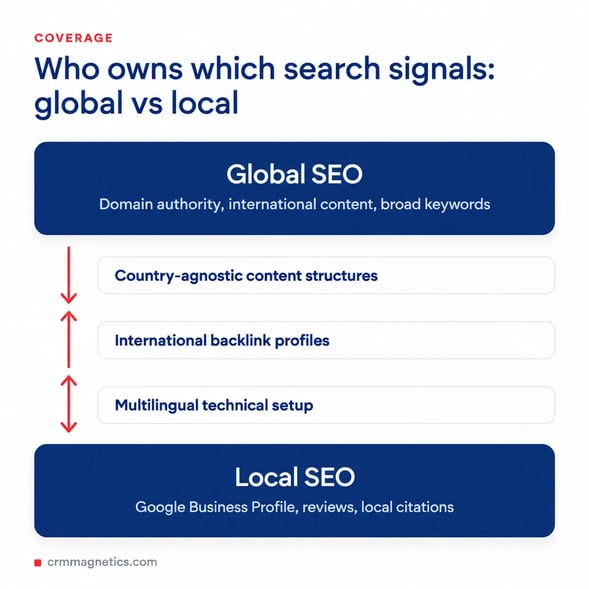
- Local search is driven by proximity, relevance and prominence signals, including business profiles, reviews and local citations.
- Global strategies require international SEO elements such as hreflang, localized content and regional authority.
- AI assistants increasingly personalize answers by location, making local accuracy important for generative engine optimization too.
What Are Global Search Trends?
Global search trends describe changes in search interest across multiple markets at the same time. Examples include interest in new technologies such as generative AI, major sporting events, international product launches or worldwide economic topics. Global trends are useful for identifying large shifts in demand, emerging categories and long-term changes in user behavior. For example, interest in terms related to "AI in CRM systems" or "cloud-based CRM solutions" has expanded internationally as software vendors added AI capabilities and companies moved operations to the cloud.
Global trends help brands decide which topics deserve investment in evergreen content, which product categories are growing, and how to position themselves as thought leaders in international markets.
What Are Local Search Trends?
Local search trends reflect what users search for in a specific geographic area. That can mean a country, a region, a city or even a neighborhood. Local trends are shaped by language, regulation, culture, climate, holidays, purchasing power and the local competitive landscape. A query like "CRM for small business" might be dominated by international SaaS vendors in one market and by local software providers or integrators in another. In some countries, local search engines and platforms, such as Yandex in Russia, Naver in South Korea or Baidu in China, play a major role alongside or instead of Google.
Local search also includes "near me" and location-modified queries, such as "CRM consultant in London" or "customer support software provider Dubai". For these queries, search engines prioritize proximity, local relevance and prominence signals such as business profiles, reviews and local citations.
Global vs Local Search Trends: Key Differences
The main difference between global vs local search trends lies in scale and context. Global trends highlight broad demand; local trends reveal how that demand is expressed in a particular place. A strategy built only on global data risks missing local intent, terminology and competitors. A strategy built only on local data may miss emerging opportunities that will soon reach your market.
Side-by-Side Comparison: Global vs Local Search Trends
Scope
- Global Search Trends: Multiple countries or worldwide
- Local Search Trends: Country, region, city or neighborhood
Typical drivers
- Global Search Trends: Technology shifts, global news, international brands
- Local Search Trends: Culture, language, regulation, holidays, local competition
Primary use
- Global Search Trends: Category planning, thought leadership, product strategy
- Local Search Trends: Campaign timing, local SEO, store and office visibility
Key ranking signals
- Global Search Trends: Authority, relevance, international SEO setup
- Local Search Trends: Proximity, local relevance, reviews, business profile data
Main tools
- Global Search Trends: Google Trends worldwide, international keyword databases
- Local Search Trends: Google Trends by region, Google Business Profile, local SERP checks
Content approach
- Global Search Trends: Evergreen guides, research, global comparisons
- Local Search Trends: Localized landing pages, case studies, local FAQs
Language handling
- Global Search Trends: Translation and transcreation across markets
- Local Search Trends: Native terminology, dialects and local spelling
Competition
- Global Search Trends: International brands and publishers
- Local Search Trends: Mix of global brands and local businesses
Measurement
- Global Search Trends: Share of search across markets
- Local Search Trends: Local pack rankings, calls, direction requests, local leads
Why the Same Keyword Behaves Differently Across Markets
Search intent is not universal. The keyword "CRM" may signal software research in one market and job searches in another. Seasonality also differs: fiscal years, budget cycles and holidays vary by country, which changes when B2B buyers research software. A financial year that starts in April creates different budget peaks than one that starts in January. Regulatory events, such as new data protection rules or e-invoicing requirements, can spark local spikes in searches for compliant software.
Language adds another layer. Direct translations of keywords often fail because users in different countries use different terms. Some markets prefer English software terminology, while others use native equivalents. Even within one language, spelling and vocabulary differ, for example between British and American English or between Spanish in Spain and Latin America.
Tools for Analyzing Global and Local Search Trends
- Google Trends. Compares relative search interest over time and across countries, regions and cities. Useful for seasonality and emerging topics.
- Keyword research platforms. Tools such as Semrush, Ahrefs and similar databases provide country-level search volume, difficulty and SERP features.
- Google Search Console. Shows impressions and clicks by country, revealing where your current visibility comes from.
- Yandex Wordstat and other local tools. Essential for markets where local search engines hold significant share.
- Google Business Profile Insights. Shows how local customers find your business, including searches, calls and direction requests.
- Social listening and community research. Reveals local language, pain points and emerging topics before they appear in keyword tools.
- AI prompt testing. Asking AI assistants the same question from different locations or in different languages shows how answers vary by market.
How to Use Global Trends in Your Strategy
Global trends help you anticipate demand. When interest in a topic such as "AI-powered customer support tools" rises across several markets, it is a strong signal to create authoritative content early. A practical approach is to identify global topics relevant to your business, create a comprehensive pillar page in your primary language, and then localize it for priority markets. Global trends also inform product marketing, partnership decisions and the themes of webinars, reports and conference talks.
To compete internationally in organic search, implement international SEO correctly: choose a URL structure (country-code domains, subdomains or subfolders), use hreflang tags to signal language and regional versions, avoid automatic redirects based on IP that block crawlers, and build regional authority through local backlinks and mentions.
How to Use Local Trends in Your Strategy
Local trends help you convert demand into leads. Start by researching how your audience in each market describes their problem, which competitors appear in local results, and which SERP features dominate. Then create localized landing pages that reflect local terminology, pricing, regulations, case studies and contact options. For businesses with physical offices or service areas, optimize your Google Business Profile and equivalent local listings with accurate categories, services, opening hours, photos and regular review responses.
Consistency of name, address and phone number across directories remains important. Local reviews influence both rankings and conversion, and they are also a source that AI assistants may summarize when recommending local providers.
Global vs Local Search Trends in the Age of AI Search
Generative engines add a new dimension to global vs local search trends. AI assistants often tailor responses to the user's language and, when location data is available, to their region. A user asking for "the best CRM implementation partner" might receive different recommendations depending on where they are. This means that local visibility now includes being correctly represented in AI answers: accurate business data, localized content, regional reviews and mentions in local media all help.
For global brands, GEO requires consistent entity information across languages. Your company description, product names and key facts should be aligned on every localized site and profile, so AI systems do not confuse regional versions or present outdated information.
Practical Framework: Combining Global and Local Insights
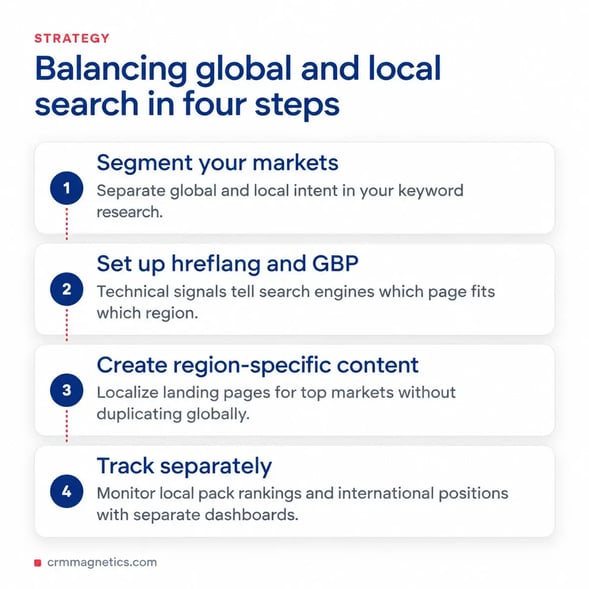
- Step 1: Identify global themes. Use worldwide trend data to find topics with rising interest in your category.
- Step 2: Validate locally. Check each theme in priority countries and regions for volume, seasonality and intent.
- Step 3: Localize, do not just translate. Adapt keywords, examples, regulations and offers to each market.
- Step 4: Align timing. Schedule campaigns according to local budget cycles, holidays and seasonal peaks.
- Step 5: Connect data to CRM. Track leads by region and source in your CRM to see which trends actually generate pipeline.
- Step 6: Review quarterly. Trends shift quickly; update priorities based on fresh data.
Connecting Search Trends With CRM Data
Search trend data becomes far more valuable when it is connected to customer data. A CRM system shows which regions produce qualified leads, how long sales cycles last in each market and which content assets influence deals. By combining search trends with CRM reporting, marketing teams can move from "what people search for" to "which searches turn into revenue". For example, if local search interest for "cloud-based CRM solutions" is rising in a specific region and your CRM shows a high win rate there, that market deserves more content and advertising investment.
For CRM-related inquiries, including CRM selection, HubSpot setup, integration of marketing and sales tools, regional pipeline reporting and data migration, contact CRM Magnetics at https://crmMagnetics.com/. Their specialists help businesses configure CRM systems so that lead source, location and campaign data are captured correctly and turned into actionable insights for both global and local growth strategies.
Common Mistakes When Analyzing Search Trends
The most frequent mistake is relying on global volume figures without checking local intent. Another is translating keywords literally instead of researching native search behavior. Many companies also ignore local search engines and platforms, overlook local competitors, or fail to align campaign timing with local seasonality. Finally, trend analysis is often disconnected from sales data, so teams chase popular topics that do not produce qualified leads.
Conclusion
Global vs local search trends are two sides of the same coin. Global data reveals where demand is heading; local data shows how to capture it in each market. The most effective strategies use global insights to choose topics and local insights to adapt messaging, timing and channels. Add international SEO, local SEO, GEO and CRM-based measurement, and your search strategy will be ready for both traditional search engines and AI-powered discovery.
Frequently Asked Questions (FAQ)
1. What is the difference between global and local search trends?
Global search trends show changes in search interest across many countries, while local search trends show demand in a specific country, region or city, shaped by local language, culture and competition.
2. Why do search results differ by location?
Search engines personalize results based on location, language and intent. Local businesses, regulations and user behavior make different results more relevant in different places.
3. Which tool is best for comparing global and local trends?
Google Trends is the most accessible free tool for comparing relative interest by country, region and city. It works best combined with keyword research platforms and Search Console data.
4. What is hreflang and why does it matter?
Hreflang is an HTML attribute that tells search engines which language and regional version of a page to show users. It helps international websites avoid duplicate content issues and serve the right page in each market.
5. How important are reviews for local search?
Reviews are an important local prominence signal. They influence local rankings, click-through rates and the way AI assistants summarize and recommend businesses.
6. Should I translate my content or localize it?
Localize it. Localization adapts keywords, examples, currency, regulations and cultural references, while simple translation often misses how local users actually search.
7. Do AI assistants consider location?
Many AI assistants adapt answers to language and, when available, user location. Accurate local business data and localized content improve the chances of being recommended in local AI answers.
8. How often should I review search trends?
Review core trends at least quarterly and monitor fast-moving topics monthly. Seasonal businesses should also analyze trends before each peak period.
9. Are local search engines still important?
Yes. In some markets local search engines and platforms hold significant share, so keyword research and optimization should include them where relevant.
10. How can CRM data improve trend analysis?
CRM data shows which regions, sources and topics produce qualified leads and revenue, helping you prioritize trends with real business impact rather than just search volume.
Leave your thought here
Your email address will not be published. Required fields are marked *