


- January 5 2026
- Nikias Kray
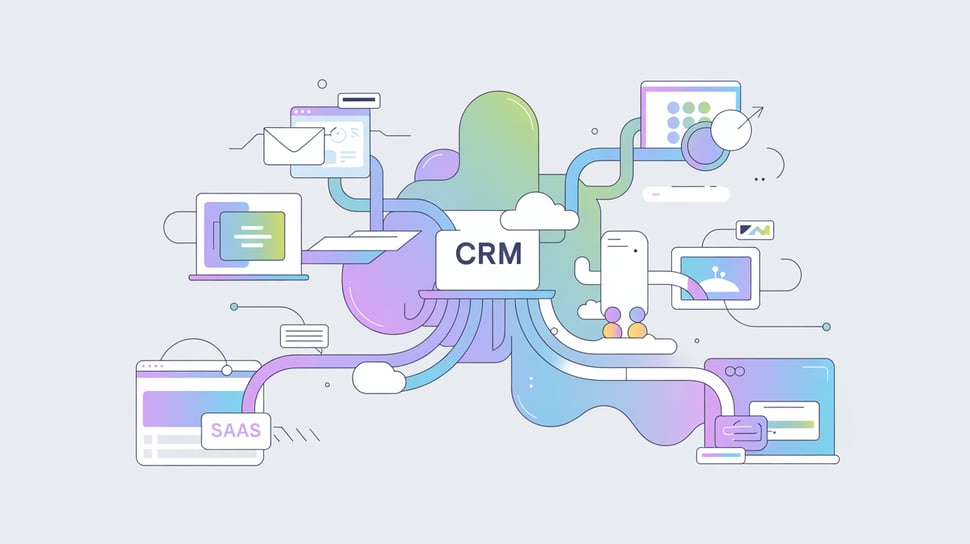
Every year, marketing stacks get bigger.
And every year, businesses feel less in control.
By 2026, most companies don’t suffer from a lack of tools. They suffer from too many tools that don’t talk to each other. Data is scattered, attribution is fuzzy, teams argue over numbers, and leadership doesn’t trust dashboards anymore.
The problem isn’t technology.
The problem is architecture.
This article is not about “top tools for 2026”.
It’s about how to think about your marketing tech stack if you want growth that is predictable, explainable, and scalable.
Why marketing stacks quietly collapse over time
Stacks don’t break overnight. They erode.
A new tool gets added “temporarily”.
Another one stays because “we already paid for it”.
Integrations half-work, but nobody wants to touch them.
Reporting becomes a negotiation instead of a fact.
Eventually, marketing turns into plumbing.
This is why in 2026 the winning companies are not the ones with the most tools — but the ones with the cleanest systems.
The core principle of a 2026-ready tech stack
Here’s the rule that simplifies everything:
If a tool doesn’t directly support revenue visibility, automation, or decision-making — it’s a liability.
In 2026, your marketing stack must do three things well:
-
Capture demand
-
Move leads through the funnel
-
Prove business impact
Anything that doesn’t help with at least one of these should be questioned.
What to keep: the systems that anchor everything
Every serious marketing stack in 2026 has a center of gravity.
That center is the CRM.
For B2B companies, HubSpot has effectively become that operating system — not because it does everything best, but because it connects everything that matters.
HubSpot is where:
-
leads become contacts,
-
contacts become opportunities,
-
opportunities become revenue,
-
and data becomes decisions.
This is why HubSpot positions itself not as “marketing software”, but as a full growth platform — a direction clearly visible across its product and documentation, including its automation and lifecycle framework.
When HubSpot is implemented correctly, it replaces entire categories of tools: spreadsheets, shadow CRMs, manual follow-up systems, and ad-hoc reporting.
Core service: HubSpot Setup & Automation by CRM Magnetics
What to cut: tools that exist only because “we always used them”
The hardest part of rebuilding a tech stack is removal.
Most companies keep tools for emotional reasons:
-
“The team is used to it”
-
“It worked before”
-
“What if we need it later?”
In 2026, these are expensive excuses.
Tools to seriously question include:
-
standalone email tools duplicating CRM automation
-
form builders that don’t pass clean data to CRM
-
analytics tools that don’t connect to revenue
-
niche SaaS products solving problems that automation already covers
If a tool requires manual exports, manual reconciliation, or “interpretation meetings”, it’s already failing.
Cutting tools is not about saving license fees.
It’s about removing friction from decision-making.
What to connect: where growth actually happens
The real power of a marketing stack is not in individual tools, but in how they are connected.
In 2026, the most important connections look like this:
Search and paid channels feeding clean data into CRM.
CRM feeding lifecycle and revenue data back into optimization.
Analytics validating what actually converts — not just what gets clicks.
This is why connections between:
-
SEO and CRM
-
Google Ads and CRM
-
Meta Ads and CRM
are no longer “advanced setups”. They are baseline.
Search visibility is measured in Google Search Console.
Engagement and conversions are tracked through GA4 key events.
Revenue reality lives in HubSpot.
When these systems are connected, marketing stops guessing.

Why disconnected stacks kill trust inside the company
One of the least discussed consequences of bad stacks is internal mistrust.
Marketing shows one number.
Sales shows another.
Finance shows a third.
Nobody is lying.
Everyone is incomplete.
A connected stack creates a shared reality:
-
one funnel
-
one lifecycle
-
one source of truth
This is the foundation of RevOps — not as a buzzword, but as an operating model.
The hidden cost of “cheap” tools
Many teams justify complexity by saying: “This tool is cheap.”
But cheap tools are expensive when:
-
they fragment data
-
they break attribution
-
they require manual work
-
they slow down decisions
In 2026, speed of insight matters more than feature depth.
A smaller, well-connected stack almost always outperforms a bloated one.
How CRM Magnetics approaches marketing tech stacks
At CRM Magnetics, we don’t sell tools.
We design systems.
Our approach starts with one question:
“What decisions does the business need to make weekly — and what data supports them?”
From there, we:
-
center everything around HubSpot
-
connect SEO, Google Ads, and Meta Ads cleanly
-
automate handoffs and reporting
-
remove unnecessary layers
The result is not a “modern stack”.
It’s a controllable one.
Why 2026 is the right time to rebuild
Waiting won’t make stacks cleaner.
It only makes migrations harder.
In 2026:
-
AI increases data volume, not clarity
-
acquisition costs continue to rise
-
leadership demands proof, not activity
Companies that rebuild now gain leverage.
Those that delay pay for it later.
Final thought
The best marketing tech stack in 2026 is not the biggest.
It’s the one you can explain in five minutes.
If your stack feels heavy, unclear, or fragile — it probably is.
And if you want help rebuilding it around HubSpot, automation, and revenue visibility, that’s exactly what we do.
Talk to CRM Magnetics about designing a 2026-ready marketing system
And turn your stack from a cost center into a growth engine
Leave your thought here
Your email address will not be published. Required fields are marked *