


- December 26 2025
- Nikias Kray

Automation in HubSpot is no longer a “nice-to-have”.
In 2026, it’s the difference between a scalable business and a fragile one.
If your revenue still depends on people remembering to follow up, updating deals manually, or moving leads between stages by hand — you’re already behind. Not because your team is bad, but because the system is outdated.
This playbook exists for one reason:
to show what a modern HubSpot setup actually looks like in 2026.
Not in theory.
Not in feature lists.
But in workflows that real B2B teams rely on every day to grow without chaos.
Why automation became the core of HubSpot in 2026
HubSpot didn’t evolve into an automation-first platform by accident.
As sales cycles became longer, channels multiplied, and buyers got harder to convince, manual processes simply stopped working.
HubSpot itself positions workflows as the backbone of scalable operations, not just marketing automation — something clearly reflected in their official documentation on HubSpot workflows.
In practice, this means one thing:
If a process repeats, it should be automated.
Not to replace people — but to protect revenue from human inconsistency.
The real purpose of workflows (most teams miss this)
Many teams think workflows exist to “send emails automatically”.
That’s a beginner’s view.
In mature HubSpot setups, workflows do something much more valuable:
they enforce discipline.
They make sure that:
-
every lead is handled the same way,
-
every deal moves through the same logic,
-
every customer gets the same baseline experience,
-
every manager sees clean, trustworthy data.
Automation doesn’t just save time.
It creates predictability — and predictability is what scales revenue.
The 25 HubSpot workflows every B2B team needs in 2026
Below is not a random list.
It’s a system, grouped by how revenue actually flows through a company.
Think of these workflows as the “minimum viable automation” for a serious B2B business.
Lead capture & first response (where most revenue is lost)
Most revenue leakage happens in the first hours after a lead arrives.
These workflows exist to make sure that never happens.
The first workflow ensures that every new lead is instantly acknowledged. Not with a generic autoresponder, but with a context-aware response that matches the source and intent.
The second workflow assigns the lead to the right owner automatically — by region, segment, deal size, or round-robin — and creates a task so nothing relies on memory.
The third workflow monitors speed-to-lead. If a lead isn’t contacted within your SLA, the system escalates it. No meetings. No reminders. Just execution.
The fourth workflow enriches and normalizes incoming data so sales doesn’t waste time cleaning records.
The fifth workflow routes high-intent leads differently from early-stage ones, ensuring senior reps focus where it matters.
Together, these workflows turn “lead generation” into lead handling — a crucial distinction many teams miss.

Lead qualification & scoring (ending the ‘bad leads’ debate)
In 2026, arguing about lead quality is a red flag.
If quality is subjective, your system is broken.
These workflows introduce objective rules.
One workflow calculates fit score based on firmographics and ICP rules.
Another calculates intent score based on behavior: page views, content consumption, demo interest.
A third workflow combines those scores into a single qualification logic and updates lifecycle stages automatically — aligned with HubSpot lifecycle stages.
A fourth workflow re-qualifies leads over time as behavior changes.
A fifth one pushes sales-ready leads forward and sends non-ready ones into nurture.
At this point, “lead quality” stops being an opinion and becomes data.
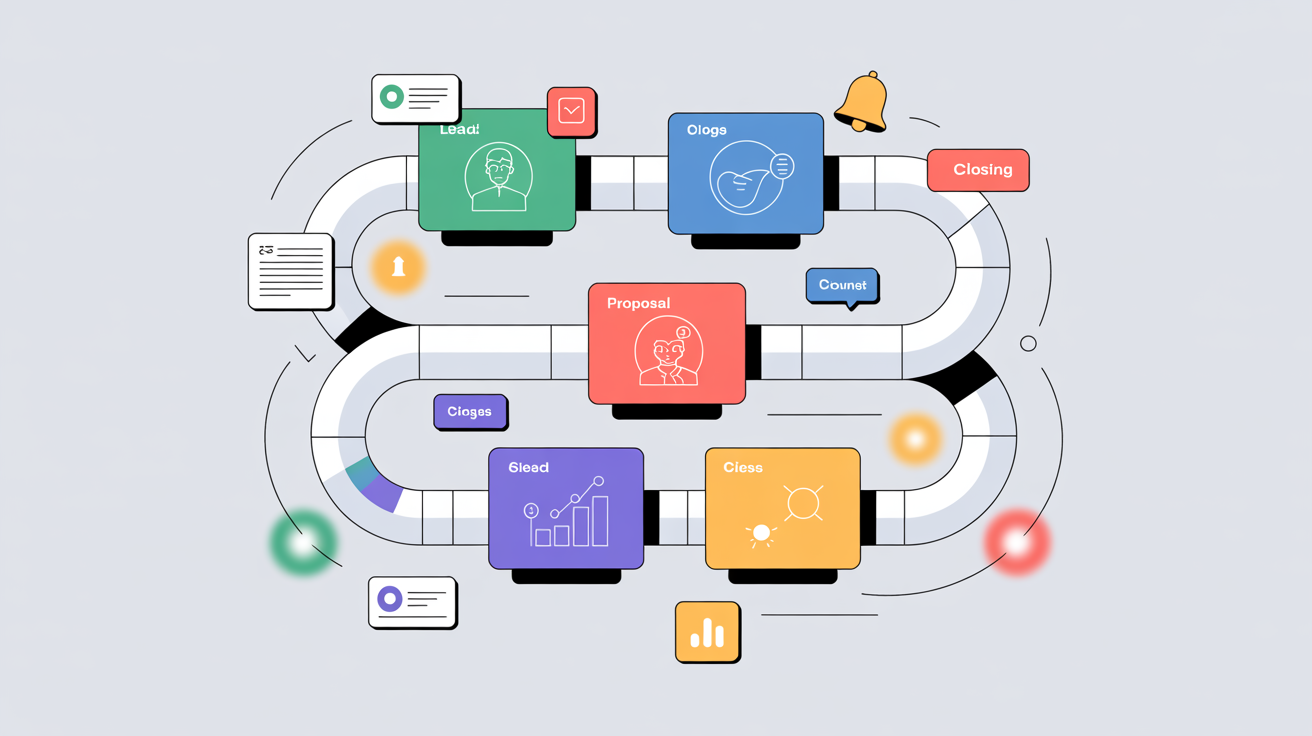
Sales pipeline & deal management (where chaos usually hides)
Sales pipelines rarely fail loudly.
They fail quietly — through stuck deals, forgotten follow-ups, and inconsistent stages.
These workflows prevent that.
One workflow auto-creates deals when a qualified meeting is booked.
Another enforces required fields before a deal can move forward, protecting forecast accuracy.
A third workflow tracks deal inactivity and alerts reps (or managers) when a deal goes stale.
A fourth updates deal stages based on real actions, not manual guesses.
A fifth closes the loop by collecting structured “lost reason” data.
Together, these workflows turn the pipeline into something you can actually trust.
Follow-up, nurturing & long-cycle deals (where most money actually is)
In B2B, the deal is rarely won on the first call.
These workflows make sure long sales cycles don’t fall apart.
One workflow triggers structured follow-up sequences after meetings.
Another pauses outreach automatically when prospects engage.
A third workflow reactivates dormant leads after predefined periods.
A fourth hands leads back to marketing without losing context.
A fifth ensures sales and marketing stay aligned on ownership.
This is where automation protects revenue that would otherwise disappear quietly.
Marketing & content automation (without spamming everyone)
Marketing automation in 2026 is no longer about “sending more emails”.
It’s about relevance.
These workflows segment audiences dynamically based on behavior.
They trigger content based on funnel stage, not calendar schedules.
They stop campaigns when someone becomes sales-owned.
They adapt messaging when a lead changes status.
This approach aligns directly with Google’s push for people-first, relevant experiences, described in Google’s Helpful Content guidelines.
Automation becomes invisible — and that’s the goal.
Analytics, reporting & revenue visibility (the part executives care about)
Automation without measurement is just motion.
These workflows ensure that:
-
conversions are tracked consistently (aligned with GA4 key events),
-
lifecycle changes are logged automatically,
-
pipeline metrics update without manual input,
-
attribution data stays clean.
When this layer exists, dashboards finally reflect reality — not optimism.
Internal operations & customer lifecycle (often forgotten)
Growth doesn’t stop at “Closed Won”.
These workflows onboard customers smoothly, trigger internal handoffs, manage renewals, and surface expansion opportunities.
They reduce internal friction and improve retention — two things far more valuable than acquiring one more lead.
Why most companies never reach this level of automation
Not because HubSpot can’t do it.
But because automation exposes bad processes.
Workflows force you to answer uncomfortable questions:
-
What is a qualified lead?
-
When is a deal real?
-
Who owns what — and when?
-
What happens if nobody acts?
Many teams avoid automation because it removes ambiguity.
But ambiguity is exactly what blocks scale.
Why this playbook works best with the right partner
You can build these workflows yourself.
Just like you can wire an entire house yourself.
The difference is speed, reliability, and long-term maintainability.
At CRM Magnetics, HubSpot automation is our core service — not an add-on. We design workflows as part of a complete revenue system: CRM structure, sales process, analytics, and growth channels working together.
If you want this playbook implemented properly, this is where to start:
HubSpot Setup & Automation by CRM Magnetics
Final thought
In 2026, the strongest companies won’t work harder.
They’ll work through systems.
HubSpot workflows are no longer about saving time.
They’re about protecting revenue, enforcing discipline, and making growth predictable.
If your automation doesn’t look like this — it’s time to rebuild it.
Talk to us about implementing HubSpot automation the right way
And turn this playbook into a working system, not just an idea
Leave your thought here
Your email address will not be published. Required fields are marked *