


- July 21 2026
- Nikias Kray
Choosing the right Customer Relationship Management (CRM) platform is one of the most consequential decisions a growing business can make. The CRM you select will shape how your sales representatives prospect, how your marketing team nurtures leads, how customer service resolves tickets, and how leadership forecasts revenue. In 2026, two names consistently appear at the top of shortlists for small and mid-sized businesses evaluating modern CRM solutions: Monday CRM and HubSpot. Both platforms have earned strong reputations, loyal user bases, and impressive feature sets, yet they take fundamentally different approaches to the problem of managing customer relationships. In this in-depth article we will use HubSpot as a benchmark to compare Monday CRM feature by feature, price by price, and workflow by workflow, so you can make a confident, informed choice for your organization.
What Is Monday CRM?
Monday CRM is the dedicated sales CRM product built on top of monday.com's flexible Work OS platform. Where the parent product monday.com started life as a general-purpose project and work management tool, Monday CRM applies that same visual, board-based philosophy specifically to the sales process. Users work with colorful, spreadsheet-like boards where every row is a lead, contact, or deal, and every column is a customizable field. Instead of forcing sales teams into a rigid, opinionated pipeline, Monday CRM invites them to build the pipeline they actually want, using drag-and-drop columns, automations, integrations, and dashboards. This flexibility has made Monday CRM extremely popular among teams that previously ran their sales process in spreadsheets and want a natural upgrade path.
Monday CRM's core promise is simple: give sales teams a beautiful, fast, highly customizable workspace where deals, contacts, and activities live side by side with the rest of the company's operational work. Because it is built on the broader monday.com Work OS, sales boards can connect seamlessly to marketing campaigns, onboarding checklists, and post-sale delivery projects, creating a single source of truth from first touch to renewal.
What Is HubSpot?
HubSpot is arguably the most well-known name in inbound marketing and CRM. Founded in 2006, HubSpot pioneered the modern concept of inbound marketing — attracting customers with valuable content instead of interrupting them with ads — and built an entire software suite around that philosophy. Today HubSpot is a full customer platform organized into interconnected 'Hubs': Marketing Hub, Sales Hub, Service Hub, Content Hub (formerly CMS Hub), Operations Hub, and Commerce Hub, all sitting on a shared, free CRM foundation.
HubSpot's Sales Hub is the most direct competitor to Monday CRM. It offers contact and company records, deal pipelines, email tracking, meeting scheduling, sequences, quotes, forecasting, and much more. Because HubSpot is a marketing company at heart, the CRM is unusually tight-integrated with content, forms, landing pages, and email marketing — a strength that Monday CRM cannot match without third-party tools.
Philosophical Differences: Flexibility vs. Depth
Before diving into features, it helps to understand the philosophical difference between these two platforms. Monday CRM is horizontally flexible: it gives you a blank canvas and lets you build any sales process you can imagine, but many of the deeper CRM features you might expect are either shallow or require add-ons. HubSpot is vertically deep: it makes strong opinions about how sales, marketing, and service should be run, and rewards teams that adopt those opinions with an incredibly powerful, integrated ecosystem — but it can feel rigid if you want to work differently.
Put another way: Monday CRM is what you choose when your team's process is unique and you value adaptability. HubSpot is what you choose when you want an industry-standard, best-practice engine and are willing to adapt your process to it.
Feature-by-Feature Comparison
Contact and Deal Management
HubSpot offers a deeply structured contact and company database. Every contact record automatically enriches with company information, social profiles, website activity, and email engagement. Deals move through customizable pipelines with required fields, stage automation, and revenue attribution. HubSpot's records feel like a true CRM database.
Monday CRM stores contacts and deals as board items. This is visually intuitive and easy to bulk-edit, but the underlying data model is less relational than HubSpot's. Linking a contact to multiple deals, tracking company hierarchies, or building complex parent-child relationships requires more manual setup. For teams with straightforward pipelines, however, Monday CRM's board view is faster and more pleasant to work in day to day.
Email Integration and Tracking
HubSpot's email integration is one of its strongest features. Two-way sync with Gmail and Outlook, open and click tracking, email templates, sequences, and AI-powered send-time optimization come standard. Reps can send tracked emails directly from the CRM or from their inbox using the HubSpot Sales extension.
Monday CRM offers Gmail and Outlook integration, email tracking, and templates as well, but the sequence engine is less mature. Cadenced outbound campaigns are possible but require more configuration, and the analytics on email performance are less granular.
Marketing Automation
This is where HubSpot has a decisive advantage. Marketing Hub, tightly integrated with the CRM, offers a full-featured marketing automation platform: landing pages, forms, email marketing, workflows, lead scoring, ABM tools, and content strategy. Monday CRM has no native marketing automation. Users typically integrate with Mailchimp, ActiveCampaign, or similar tools via monday.com's integrations marketplace.
Reporting and Dashboards
HubSpot ships with pre-built reports for every common sales, marketing, and service KPI, plus a custom report builder in higher tiers. Revenue attribution, funnel analysis, and cohort reports are available out of the box.
Monday CRM's dashboards are extremely visual and highly customizable, drawing on any board data your team maintains. However, the analytics engine is less sophisticated: multi-touch attribution, complex funnel modeling, and cross-object reporting are limited compared to HubSpot.
Automation and Workflows
Both platforms have strong automation engines. Monday CRM uses a plain-language 'when this happens, do that' recipe builder that non-technical users find approachable. HubSpot's workflow tool is more powerful, with branching logic, delays, goal tracking, and cross-object triggers, but has a steeper learning curve.
AI and Copilot Features
As of 2026, both vendors have invested heavily in AI. HubSpot Breeze provides AI agents for content generation, prospecting, customer service, and social media, plus an AI assistant embedded across the platform. Monday CRM offers monday AI for drafting emails, summarizing deals, and generating formulas, with a growing library of AI blocks that can be dropped into any board.
Integrations and Ecosystem
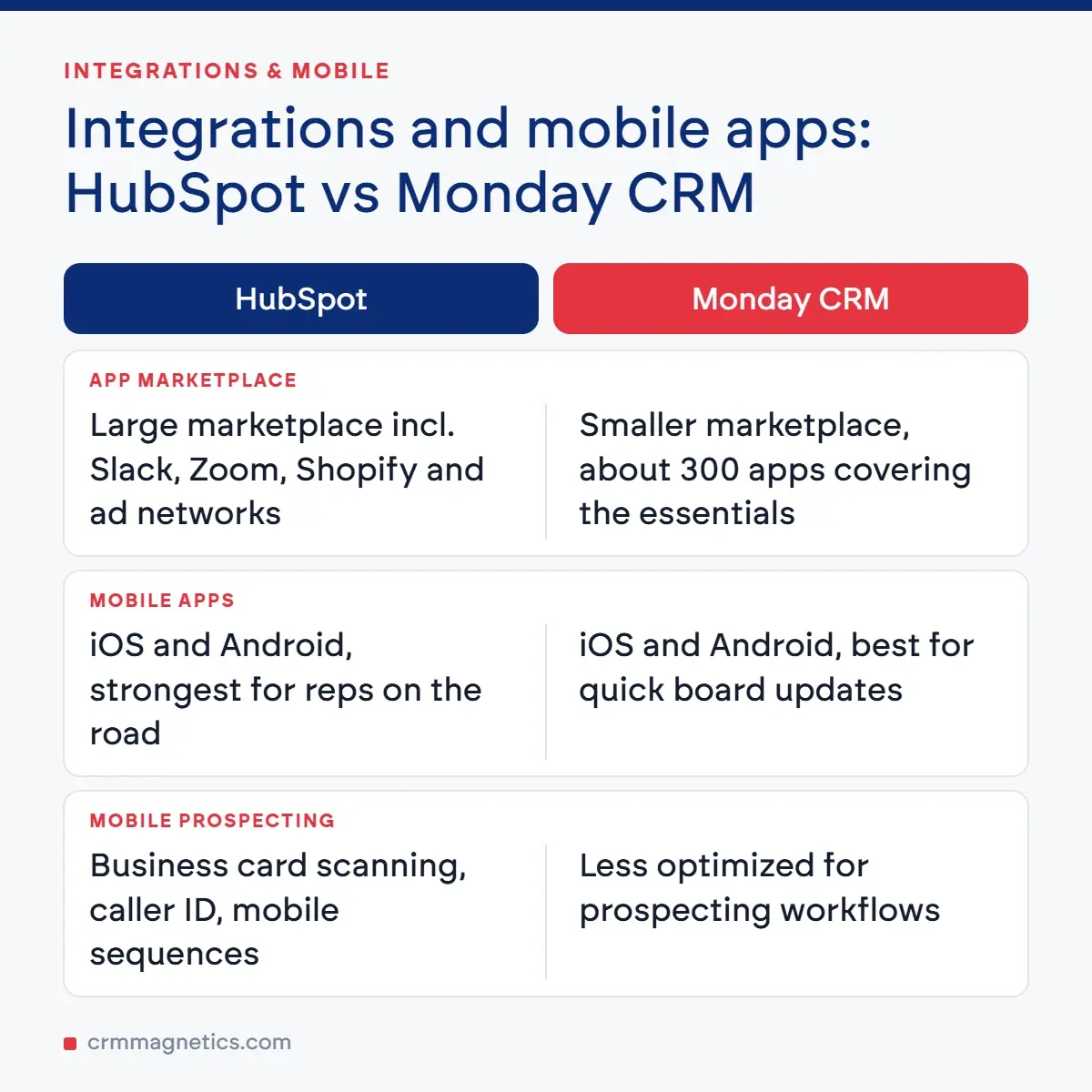
HubSpot's App Marketplace lists more than 1,700 integrations, including deep native connections to Salesforce, Slack, Zoom, Shopify, and major ad networks. Monday.com's marketplace has fewer entries — closer to 300 — but covers the essentials and, because of the platform's popularity in tech, integrations tend to be well-maintained.
Mobile Apps
Both platforms have solid iOS and Android apps. HubSpot's mobile experience is more feature-complete for sales reps on the road (business card scanning, caller ID, mobile sequences). Monday CRM's mobile app excels at quick updates to boards but is less optimized for pure prospecting workflows.
Pricing
Pricing is where the platforms diverge sharply. HubSpot offers a genuinely free CRM tier with unlimited users and generous limits, then charges for Sales Hub, Marketing Hub, and Service Hub in tiers (Starter, Professional, Enterprise) that can become expensive quickly, especially as contact counts scale. Monday CRM charges per user per month with no free tier for teams larger than 2 users, but pricing stays relatively predictable as you grow because it does not scale with contact volume.
Comparison Table: Monday CRM vs HubSpot
|
Feature / Criterion |
Monday CRM |
HubSpot |
|
Free plan |
Free for up to 2 users only |
Free CRM with unlimited users |
|
Starting paid price (2026) |
≈ $12 / user / month (Basic) |
Sales Hub Starter ≈ $20 / seat / month |
|
Pricing model |
Per user, seat-based |
Per seat + contact tiers for Marketing |
|
Contact database |
Board-based, flexible |
Relational, deeply structured |
|
Pipeline customization |
Excellent (drag & drop) |
Very good, more rigid |
|
Email tracking & sequences |
Basic to intermediate |
Advanced, industry-leading |
|
Marketing automation |
Requires integration |
Native (Marketing Hub) |
|
Landing pages / forms |
Not native |
Native |
|
Reporting |
Visual dashboards, limited attribution |
Rich reports, multi-touch attribution |
|
Automations / workflows |
No-code recipes, easy |
Powerful, more complex |
|
AI features |
monday AI (drafting, summaries) |
Breeze AI agents & copilot |
|
Integrations |
≈ 300+ apps |
1,700+ apps |
|
Mobile app |
Strong for board updates |
Strong for field sales |
|
Best for |
Teams wanting flexible, visual pipelines |
Teams wanting full marketing + sales suite |
|
Learning curve |
Low to moderate |
Moderate to high |
|
Customer support |
24/7 chat, knowledge base |
24/7 chat & phone (paid tiers), academy |
Use Cases: When to Choose Which
Choose Monday CRM if...
You are a small to mid-sized team that already uses monday.com for project or work management and want your sales data to live in the same ecosystem. You value visual pipelines, easy customization, and a low learning curve. Your marketing is handled by a separate tool (or by an outside agency) and you do not need marketing automation built into your CRM. You want predictable, seat-based pricing that does not balloon with contact growth.
Choose HubSpot if...
You run — or plan to run — an inbound marketing motion where content, SEO, landing pages, forms, and email nurture campaigns are central to acquiring customers. You want a single vendor for marketing, sales, and service and are willing to invest in learning a more opinionated platform. You need advanced reporting, attribution, and forecasting. You anticipate scaling to hundreds or thousands of contacts and can budget for tiered pricing.
Migration Considerations
Migrating between CRMs is never trivial. Both HubSpot and Monday CRM offer CSV import tools, native migration wizards for common source systems (Salesforce, Pipedrive, Zoho), and partner ecosystems full of certified implementation specialists. Before migrating, map your fields carefully, decide which historical activities you truly need to preserve, and always run a pilot import with a small subset of records before committing.
Implementation Best Practices
Regardless of which CRM you choose, successful implementation follows the same principles. First, document your sales process on paper before configuring anything in software. Second, keep the initial setup lean — you can always add fields later, but removing junk data is painful. Third, invest in training; the best CRM in the world is worthless if reps do not adopt it. Fourth, connect the CRM to the tools your team already uses daily, especially email and calendar. Finally, review reports weekly for the first quarter to catch bad data hygiene before it compounds.
Need Help Choosing or Implementing Your CRM?
If you would like expert guidance selecting, migrating to, or optimizing a CRM — whether Monday CRM, HubSpot, or another platform — the team at CRM Magnetics can help. Our consultants specialize in configuring modern CRMs to fit real sales processes, automating routine work, and training teams so adoption sticks. Learn more and book a free consultation at https://crmmagnetics.com/. Whether you are starting from scratch, escaping a spreadsheet, or replacing a CRM that no longer fits, we can save you months of trial and error and thousands of dollars in wasted subscriptions.
Final Verdict
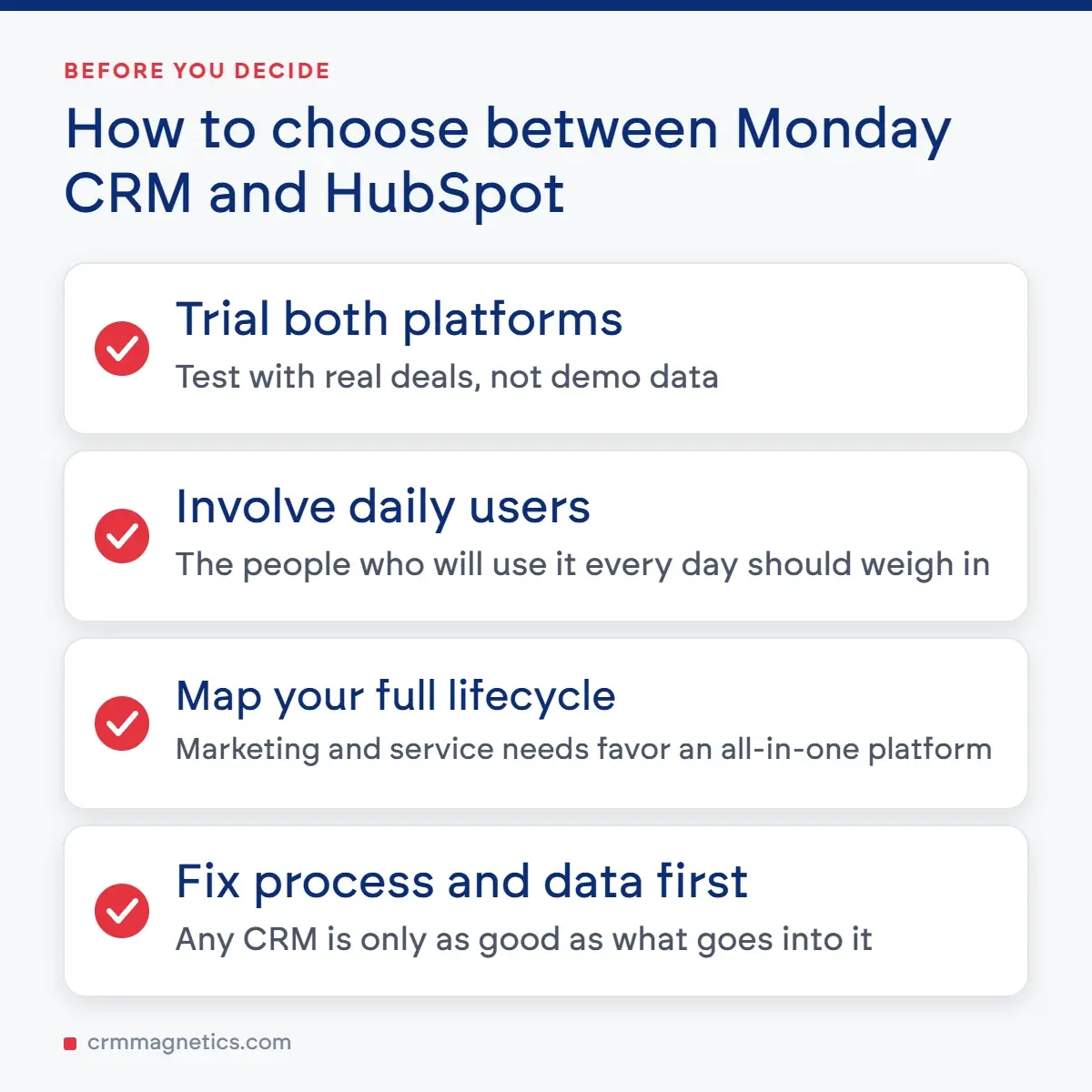
There is no universal winner in the Monday CRM vs HubSpot debate — the correct answer depends entirely on your team's shape, budget, and go-to-market motion. Monday CRM shines for operationally minded teams that want a flexible, visual workspace that mirrors how they actually work. HubSpot shines for marketing-driven organizations that want a deeply integrated, best-practice platform covering the full customer lifecycle. Test both with a free trial, involve the people who will use the tool daily in the evaluation, and remember that any CRM is only as good as the process and the data behind it.
Frequently Asked Questions (FAQ)
1. Is Monday CRM cheaper than HubSpot?
Answer 1: For very small teams with no marketing needs, Monday CRM is usually cheaper because its pricing is purely per user and does not scale with contact count. HubSpot's free CRM can also be cheaper for larger teams that only need basic contact management. Once you add HubSpot's Sales or Marketing Hub Professional tier, HubSpot becomes significantly more expensive than Monday CRM.
2. Does Monday CRM offer a free plan?
Answer 2: Monday CRM offers a free plan limited to 2 users with basic functionality. For teams larger than 2, a paid plan is required. HubSpot, by contrast, offers a free CRM tier with unlimited users, which is a genuine advantage for very small or bootstrapped teams.
3. Can Monday CRM replace HubSpot entirely?
Answer 3: For sales pipeline management, yes. For marketing automation, landing pages, forms, and email nurture campaigns, no — Monday CRM has no native marketing suite. Teams replacing HubSpot with Monday CRM usually pair it with a dedicated marketing tool such as Mailchimp, ActiveCampaign, or Customer.io.
4. Which CRM has better reporting and analytics?
Answer 4: HubSpot has more advanced out-of-the-box reporting, including multi-touch attribution, funnel analysis, and revenue forecasting. Monday CRM offers highly customizable visual dashboards but less depth in analytical modeling.
5. How steep is the learning curve for each platform?
Answer 5: Monday CRM has a gentler learning curve, especially for users coming from spreadsheets. HubSpot is more opinionated and feature-dense, so new users typically need a few weeks of training to become fully productive.
6. Do both platforms support AI features in 2026?
Answer 6: Yes. HubSpot offers Breeze AI agents and an AI copilot across the platform, focused on content, prospecting, and service. Monday CRM offers monday AI for email drafting, deal summaries, and formula generation, plus AI blocks that can be added to boards.
7. Which platform integrates with more third-party apps?
Answer 7: HubSpot has a larger marketplace with 1,700+ integrations. Monday.com's marketplace has around 300+ integrations, which still covers most mainstream tools but may lack niche or industry-specific connectors.
8. Is data migration between Monday CRM and HubSpot straightforward?
Answer 8: Both platforms support CSV import and have partner ecosystems specializing in migration. Migrating from HubSpot to Monday CRM is generally easier because Monday CRM's data model is simpler. Migrating from Monday CRM to HubSpot may require mapping flat board fields into HubSpot's structured objects.
9. Which CRM is better for e-commerce businesses?
Answer 9: HubSpot has a dedicated Commerce Hub, native Shopify integration, and stronger tools for tracking customer lifetime value across touchpoints, making it the stronger choice for e-commerce. Monday CRM can be used for e-commerce but usually requires additional integrations.
10. Can I try both platforms before committing?
Answer 10: Yes. HubSpot offers a free tier plus free trials of paid Hubs. Monday CRM offers a 14-day free trial of all paid features. We strongly recommend piloting both with real data before committing to a long-term contract.
11. Does either CRM support multiple sales pipelines?
Answer 11: Both do. Monday CRM lets you create as many boards and pipelines as you want on any paid plan. HubSpot allows multiple pipelines starting from Sales Hub Starter, with more pipelines available on higher tiers.
12. Which CRM is better for remote or distributed sales teams?
Answer 12: Both are cloud-native and work well for distributed teams. HubSpot has a slight edge for field sales thanks to a more mature mobile app and calling features, while Monday CRM excels for remote teams that value visual collaboration across sales, marketing, and delivery boards.
Leave your thought here
Your email address will not be published. Required fields are marked *