


- March 9 2026
- Nikias Kray
The digital landscape has shifted. The speed to lead standard once a generous five minutes has collapsed to mere seconds. Buyers are armed with AI agents that pre-screen vendors before a human ever visits your website. In this hyper-accelerated environment, the margin for error in your CRM is non-existent. If your lead management process is a tangled web of manual handoffs, vague definitions, and cherry-picking sales reps, you aren’t just losing efficiency, you are actively bleeding revenue.
For revenue operations (RevOps) leaders and marketing managers, HubSpot has evolved from a marketing automation platform into the central nervous system of the customer journey. But a powerful tool is dangerous without a blueprint. To survive the competitive density of 2026, you must master the holy trinity of lead management: Scoring, Routing, and SLAs.
This guide will walk you through how to architect a high-velocity, low-chaos lead management engine in HubSpot, ensuring that no opportunity slips through the cracks.
The State of the Union
Before diving into the mechanics, we must acknowledge the context. By 2026, HubSpot’s Breeze intelligence and AI layers have matured significantly. We are no longer just looking at static properties (Job Title, Industry).
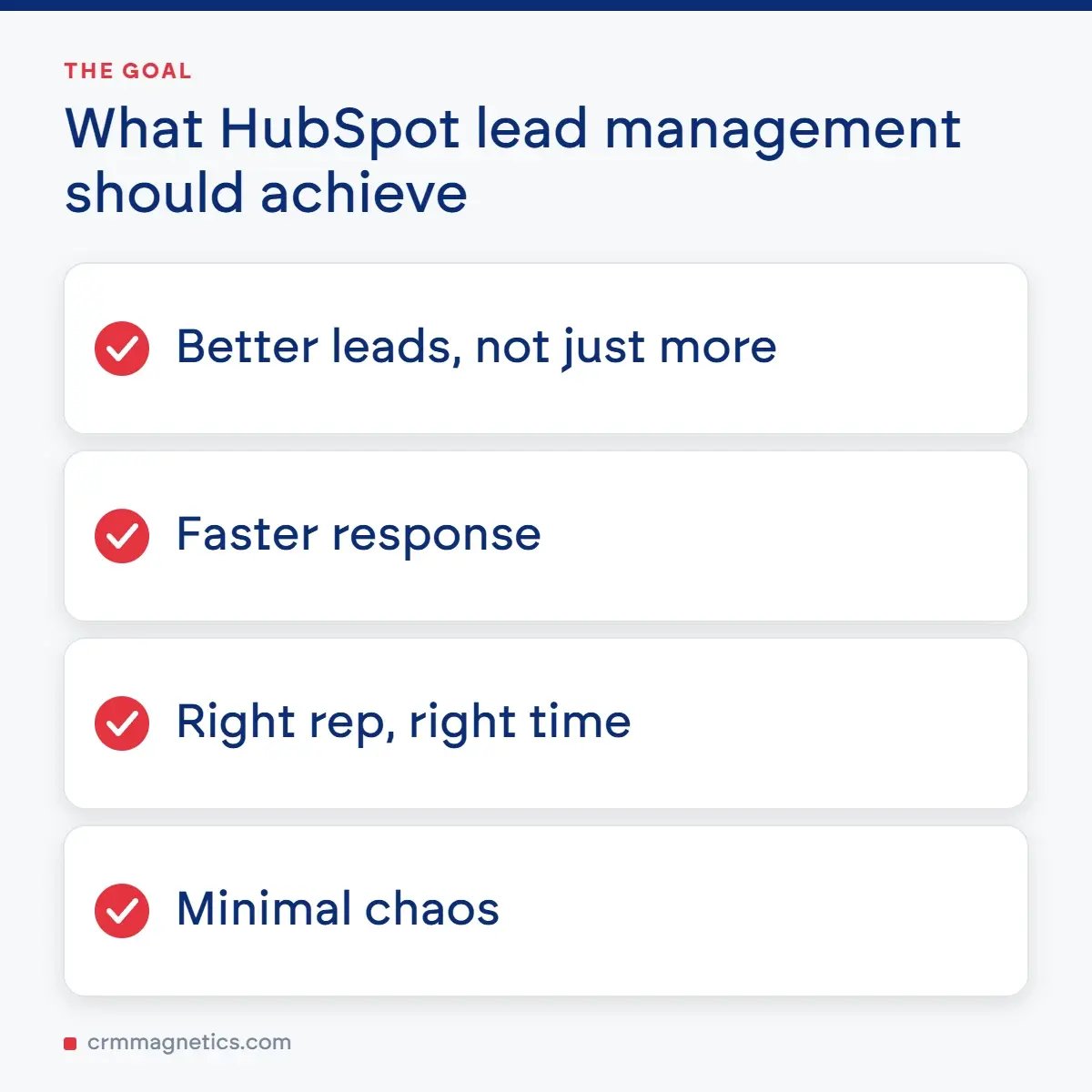
The chaos usually stems from a disconnect between the volume of data coming in and the capacity of the sales team to process it. The goal of modern lead management is not just more leads. It is better leads, faster. This requires a shift from linear funnels to dynamic flywheels where data hygiene, automation, and human accountability intersect.
The Precision of Lead Scoring
In the early 2020s, lead scoring was often a blunt instrument. A download was worth 10 points a page view was worth 2. This resulted in false positives students downloading whitepapers who looked like hot leads but had zero purchasing power.
In 2026, lead scoring hubspot strategies have shifted toward predictive modeling and intent data. If you are still relying solely on manual point assignments, you are behind.
The Split
To avoid chaos, you must decouple your scoring models. A high score should not be a monolith; it should be a coordinate on a map.
- Fit Score (Demographic/Firmographic): This is static. Is the company the right size? Is the contact a decision-maker? Do they use compatible technology? In HubSpot, this should be a 0-100 score based purely on ideal customer profile (ICP) data.
- Engagement Score (Behavioral): This measures activity with you. Did they open emails? Did they attend a webinar? This score should degrade over time. A lead who was active three months ago but silent since is not hot.
- Intent Score (Third-Party/AI): This is the 2026 differentiator. Using HubSpot’s Breeze intelligence and integrations with tools like 6sense or G2, are they researching your category? Are they looking at your competitors?
Implementing Negative Scoring
Chaos ensues when sales reps waste time on bad fits. Your lead scoring hubspot setup must be punitive for disqualifying factors.
- Competitors: If the email domain matches a known competitor, the score drops to -100.
- Career Seekers: Visits to the Careers page should deduct points.
- Geographic Mismatches: If you only sell to North America, a lead from a restricted region should be auto-disqualified via scoring logic, preventing it from ever hitting a routing workflow.
The Surge Threshold
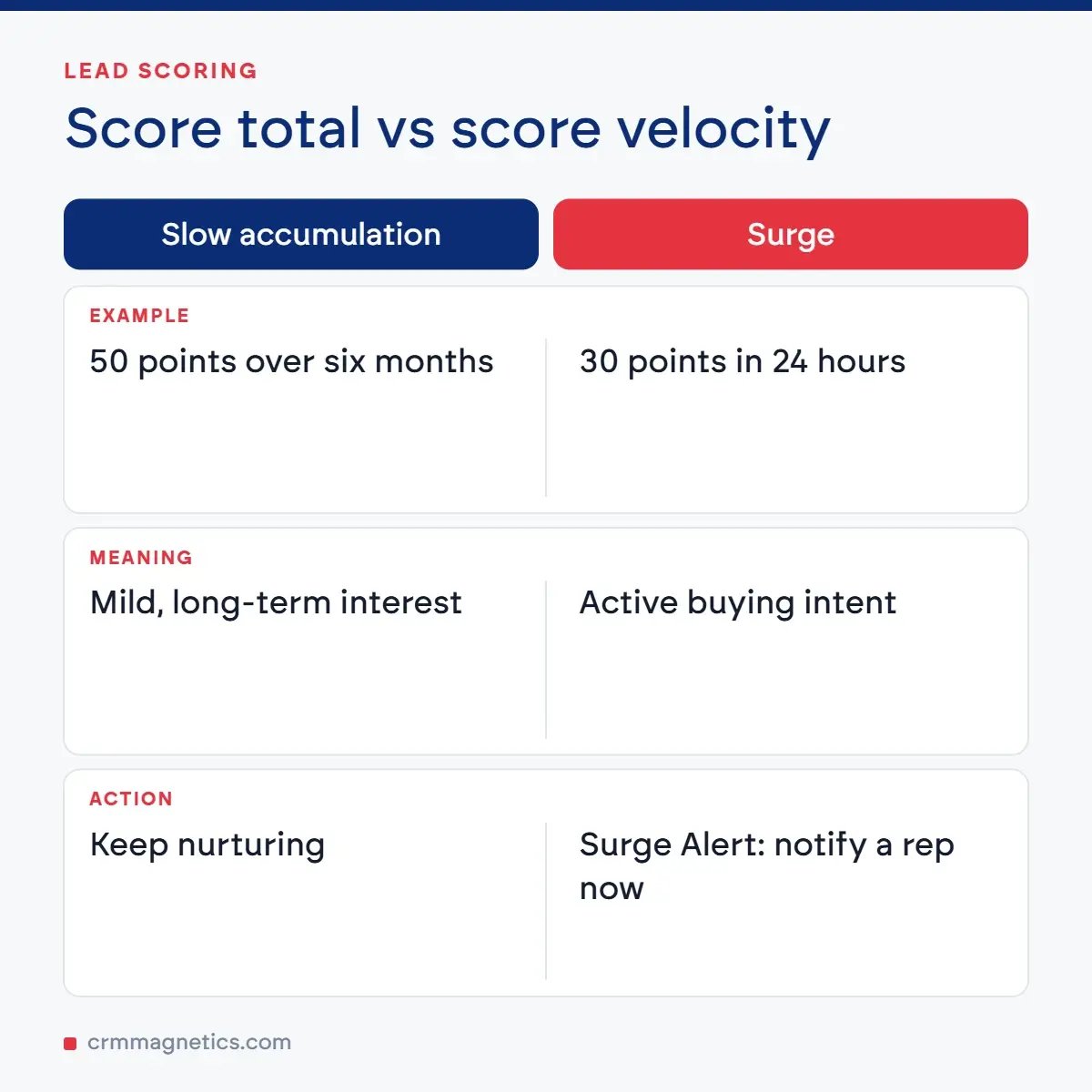
In 2026, we don't just wait for a score to hit 100. We look for velocity. If a lead accumulates 30 points in 24 hours, that is more valuable than a lead who accumulated 50 points over six months. Use HubSpot workflows to trigger a Surge Alert property when rapid point accumulation occurs, bypassing standard nurturing to alert a rep immediately.
The Velocity of Lead Routing
Once a lead is scored and deemed Sales Ready, where does it go? The Black Hole of lead routing is where most revenue is lost. A lead sits in a general queue, or worse, is assigned to a rep who is on vacation.
Effective lead routing hubspot architecture in 2026 relies on automated, logic-based distribution that accounts for territory, capacity, and expertise.
The Hierarchy of Routing Logic
Do not build a flat routing system. Build a waterfall.
- Tier 1: Ownership Check. Before routing to a new rep, the system must check: Does this lead (or their company) already have an owner? If yes, route to the existing owner to preserve the relationship.
- Tier 2: Territory/Vertical. If unowned, route based on hard criteria. North East region? Healthcare vertical? Enterprise segment?
- Tier 3: Round Robin. If the lead fits a general pool, use HubSpot’s native weighted round-robin features.
Weighted Rotation and Shark Tanks
Not all sales reps are created equal. In 2026, high-performing organizations use weighted lead routing hubspot features.
- The Meritocracy Model: Senior reps with higher close rates receive 150% of the lead flow compared to junior reps. This is easily configured in HubSpot’s Sales Hub settings.
- The Shark Tank: For lower-tier leads that don't merit a specific assignment, route them to a shared Unassigned view (the Shark Tank) and alert the team. First to claim gets the lead. This gamifies the process for hungry SDRs.
Availability-Based Routing
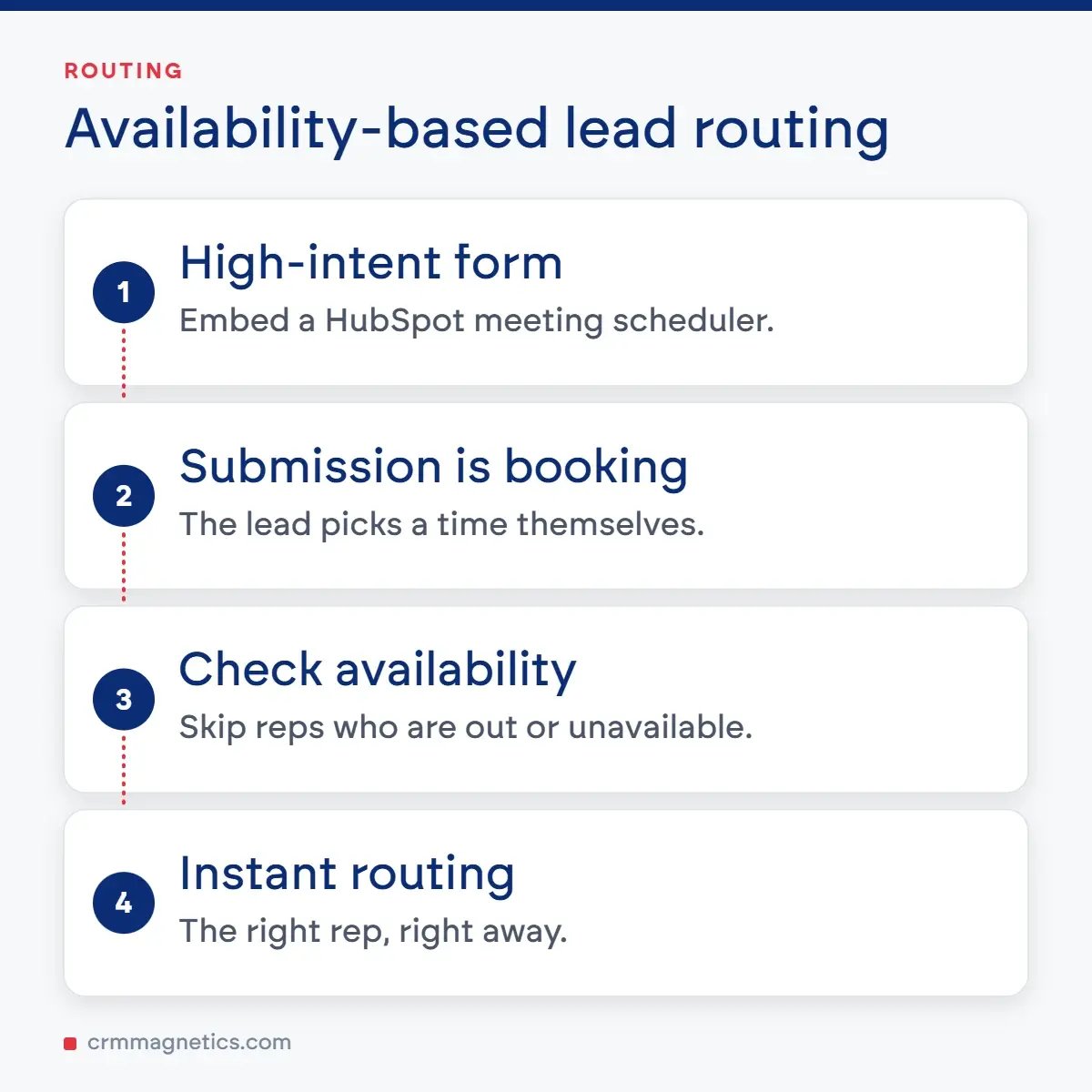
Nothing creates chaos like routing a hot demo request to a rep who is out of office. Modern routing workflows must check the rep's calendar availability.
- The Meeting Link Bypass: The best routing is the one the customer does themselves. Embed HubSpot meeting schedulers on your high-intent forms. The form submission is the booking. The routing happens instantly based on whose calendar is displayed.
- Logic: If a rep has status checked in their user profile, the workflow must skip them in the round-robin rotation.
The Accountability of SLAs
You have scored the lead. You have routed the lead. Now, the clock starts. A Service Level Agreement (SLA) is not a suggestion it is a contract between Marketing and Sales. Marketing agrees to deliver a certain quality of lead (MQL), and Sales agrees to work it within a specific timeframe.
Without SLAs, lead routing hubspot mechanisms are just pipes leading to nowhere.
Defining the SLA Metrics
In 2026, we track two critical metrics:
- Time to First Action: How many minutes passed between the MQL status change and the first call or email?
- Follow-up Frequency: Did the rep try once and give up? An SLA should dictate a minimum cadence (e.g., 6 touches in 10 days).
Automating the Nudge and the Clawback
HubSpot workflows are the enforcers of the SLA.
- The Warning (The Nudge): If an MQL has been assigned for 30 minutes with no activity (call logged, email sent, meeting booked), send a Slack notification to the rep.
- The Breach (The Clawback): If 60 minutes pass with no activity, the system automatically re-assigns the lead to the next available rep and notifies the sales manager. This sounds harsh, but in a high-velocity 2026 market, hoarding leads is unacceptable.
Reporting on SLA Adherence
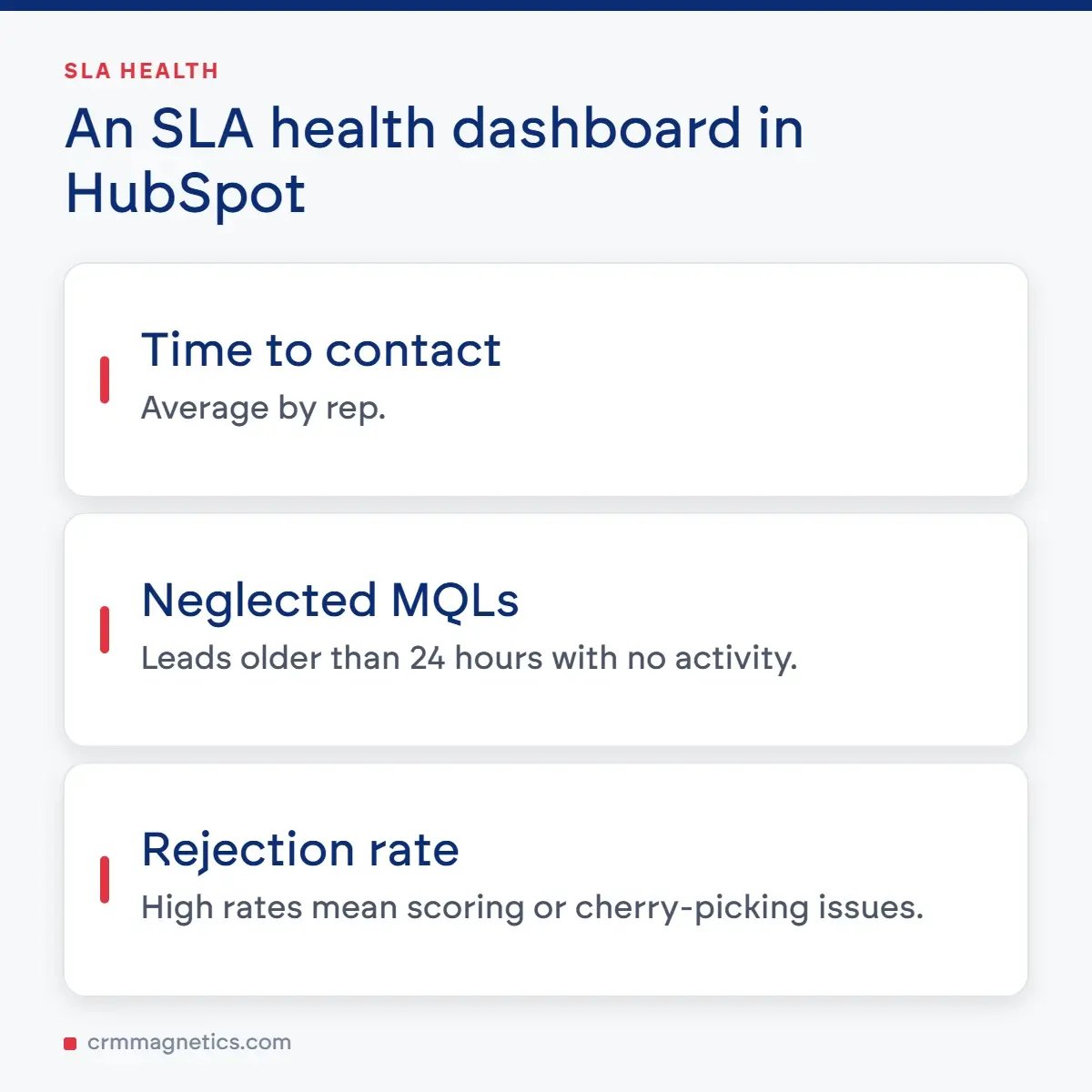
You cannot manage what you don't measure. Create a specific dashboard in HubSpot for SLA Health.
- A bar chart showing Average Time to Contact by Rep.
- A list of Neglected MQLs (Leads > 24 hours old with 0 activity).
- Lead Rejection Rate. If a rep rejects 50% of their leads as bad quality, either the scoring model is broken, or the rep is cherry-picking. Both require investigation.
The No Chaos Framework
Even the best systems degrade over time. Entropy is the enemy of CRM. To maintain a chaos-free environment for lead scoring hubspot and routing, you need a governance strategy.
The Smarketing Feedback Loop
The most common source of chaos is the Quality vs. Quantity argument.
- The Fix: Implement a mandatory Disqualification Reason field. If a rep moves a lead to Unqualified, they must select a reason (e.g., No Budget, Competitor, Bad Contact Info).
- The Review: Monthly meetings where Marketing reviews these reasons. If 40% of leads are No Budget, Marketing needs to adjust ad targeting or the lead scoring hubspot threshold.
Data Hygiene Automation
Routing breaks when data is missing. You cannot route by State if the State field is empty.
- Enrichment: Use HubSpot’s Breeze intelligence to auto-fill firmographic data.
- Normalization: Use Operations Hub to standardize data. Ensure NY, New York, and N.Y. all normalize to NY so your territory routing doesn't fail.
Lifecycle Stage Integrity
Chaos reigns when definitions are loose. Ensure your HubSpot portal has rigid automation for Lifecycle Stages.
- A lead automatically becomes an MQL when they hit the score threshold.
- A lead automatically becomes an SQL when a deal is created.
- A lead automatically recycles to Nurture if the deal is lost.
- Do not allow humans to manually toggle these stages arbitrarily without validation.
The 2026 Standard
By 2026, the technology available within HubSpot allows for a level of precision that was previously the domain of enterprise-grade, custom-coded ERPs. However, the technology is only as good as the logic you feed it.
If you implement predictive lead scoring hubspot models that prioritize intent over vanity metrics, build lead routing hubspot workflows that respect territory and capacity, and enforce SLAs with automated accountability, you will achieve the holy grail of RevOps: Predictable Revenue.
The chaos of the past leads lost in inboxes, arguments over lead quality, and slow response times is a choice. With the right architecture, your HubSpot portal becomes a silent, efficient engine, delivering the right lead to the right rep at the exact moment they are ready to buy.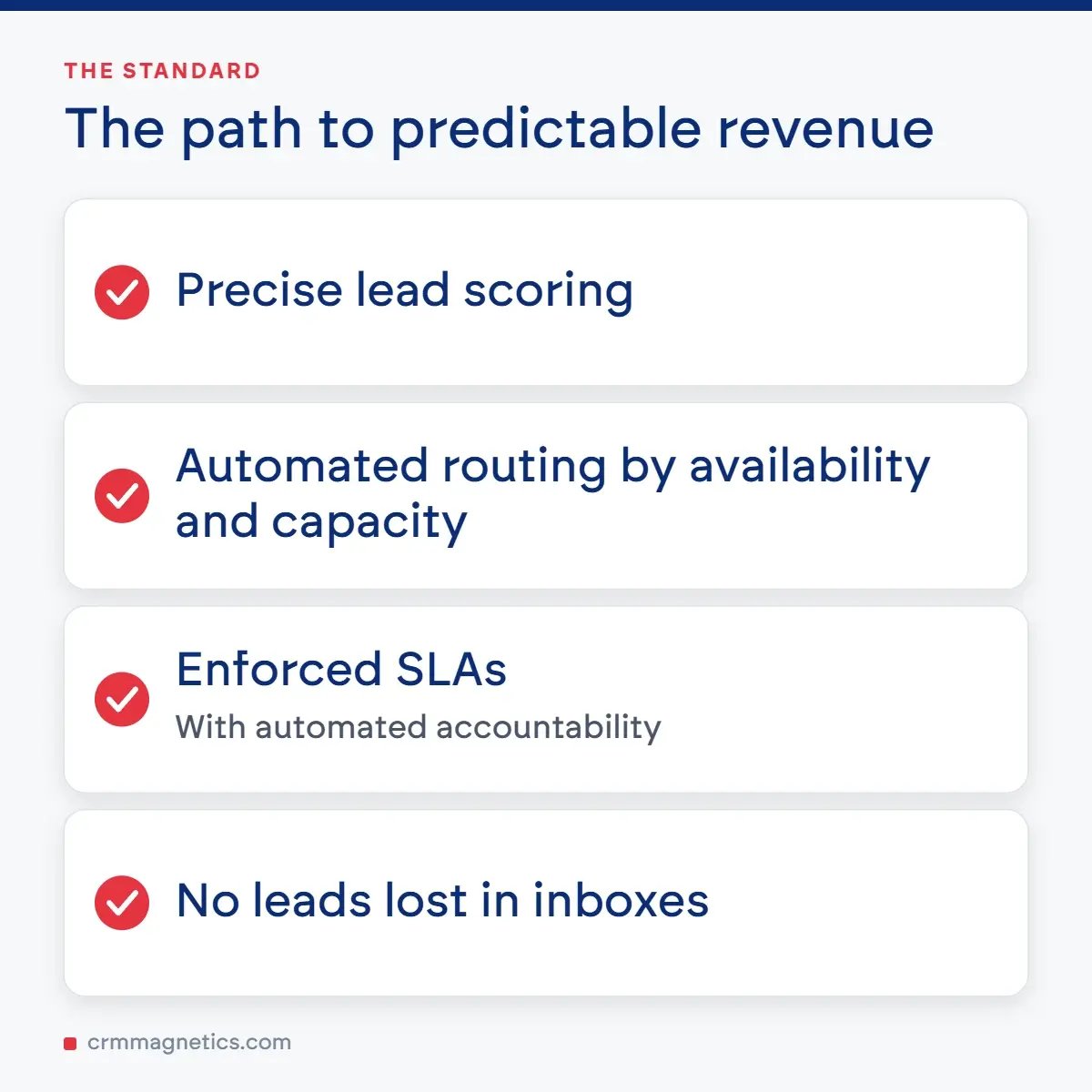
Summary Table
|
Section |
Key Concept |
What It Means in Practice |
HubSpot Focus Area |
|
State of the Union |
From funnels to flywheels |
Shift to dynamic, always-on systems where data, automation, and accountability intersect |
Overall RevOps architecture |
|
Lead Scoring |
Fit / Engagement / Intent split |
Separate models for who they are, what they do, and what they intend to buy |
Predictive scoring, Breeze, integrations |
|
Negative Scoring |
Punishing bad fits |
Deduct points for competitors, job seekers, wrong regions |
Lead scoring rules & exclusion logic |
|
Surge Threshold |
Scoring velocity, not just volume |
Trigger alerts when score jumps quickly (e.g., +30 in 24 hours) |
Workflows & custom properties |
|
Lead Routing |
Waterfall logic |
Ownership check → territory/vertical → round robin |
Assignment workflows & ownership rules |
|
Weighted Rotation & Shark Tank |
Meritocratic and self-serve assignment |
Senior reps get more leads; low-priority leads go to a shared “grab pool” |
Weighted rotation, shared views |
|
Availability-Based Routing |
Calendar-aware distribution |
Skip OOO reps; use meeting links for self-routing |
Meeting links, user status, workflows |
|
SLAs |
Contract between Marketing & Sales |
Time-to-first-action and follow-up cadence are enforced, not suggested |
SLA properties, workflows, alerts |
|
SLA Enforcement |
Nudge & Clawback |
Reminders at 30 minutes; auto reassignment at 60 minutes of inactivity |
Slack/email alerts, reassignment workflows |
|
Governance (“No Chaos”) |
Smarketing loop & data hygiene |
Required disqualification reasons, enrichment, normalization |
Disposition fields, Operations Hub, Breeze |
|
Lifecycle Integrity |
Rigid automation of stages |
Auto-MQL on score, auto-SQL on deal, auto-recycle on loss |
Lifecycle workflows & stage definitions |
|
2026 Standard |
Precision and predictability |
Technology + clear logic = predictable, scalable revenue |
End-to-end RevOps design in HubSpot |
FAQ
1. What is the main goal of HubSpot lead management in 2026?
The goal is not just to generate more leads, but to generate better leads faster, and route them to the right reps at the right time with minimal chaos. This is achieved through precise scoring, automated routing, and enforced SLAs, all powered by HubSpot’s AI and workflow capabilities.
2. Why do we need three separate scores (Fit, Engagement, Intent)?
Because a single “lead score” hides important nuance:
- Fit Score tells you who the lead is and whether they match your ICP.
- Engagement Score tells you how they are interacting with your brand.
- Intent Score tells you what they are researching in the market (your category/competitors).
Decoupling these helps Sales understand whether a lead is a great fit but cold, a poor fit but highly active, or a high-intent buyer who needs immediate attention.
3. What is negative scoring and why is it important?
Negative scoring is the practice of removing points for attributes or behaviors that indicate a poor fit. Examples:
- Competitor domains
- Career page visits (job seekers)
- Out-of-geo leads when you serve only certain regions
This prevents bad-fit leads from being treated as high-priority and protects sales capacity.
4. What is the “Surge Threshold” and how is it different from a standard score threshold?
- A standard score threshold looks at total points (e.g., 100 points = MQL).
- A Surge Threshold looks at how quickly those points accumulate (e.g., +30 in 24 hours).
A lead with rapid scoring velocity is often showing strong buying intent and should trigger an immediate alert, even if the absolute score is still lower than your usual MQL threshold.
5. How should lead routing be structured in HubSpot?
Use a waterfall hierarchy:
- Ownership Check: If the contact or company already has an owner, route to them.
- Territory/Vertical: If unowned, route based on region, vertical, or segment.
- Round Robin: If it fits a general pool, distribute using weighted round robin.
This preserves relationships, respects territory rules, and ensures fair distribution.
6. What is weighted lead routing and when should I use it?
Weighted routing assigns more leads to higher-performing reps (e.g., senior reps get 150% of the volume compared to juniors). Use it when:
- You have measurable differences in performance.
- You want to maximize revenue by giving more at-bats to closer reps.
- You still want to feed juniors enough volume to ramp and grow.
7. What is the “Shark Tank” model?
The “Shark Tank” is a shared pool of lower-priority leads:
- Leads are routed into an “Unassigned” or shared view.
- Reps are alerted and can claim leads on a first-come, first-served basis.
- This gamifies lead acquisition and ensures even low-priority leads can be worked by hungry SDRs.
8. How does availability-based routing work?
Availability-based routing ensures hot leads are not sent to reps who are out of office:
- Workflows check rep status or calendar signals.
- OOO reps are skipped in round robin.
- High-intent forms use meeting links so the prospect self-books into an available slot, effectively routing themselves.
9. What SLAs should we define for Sales in HubSpot?
Two core SLA metrics:
- Time to First Action: How many minutes from MQL to first email/call/meeting.
- Follow-up Frequency: Minimum number of touches over a defined period (e.g., 6 touches in 10 days).
These SLAs create a measurable contract between Marketing (lead quality) and Sales (lead follow-up).
10. How do we enforce SLAs in HubSpot?
With workflows:
- Nudge: If no activity within 30 minutes of assignment, send a Slack or email reminder.
- Clawback: If no activity within 60 minutes, automatically reassign the lead to another rep and notify the manager.
This removes “lead hoarding” and keeps hot leads moving.
11. What reports should we use to monitor SLA health?
Create an SLA dashboard with:
- Average Time to First Contact by Rep
- Neglected MQLs: Leads older than 24 hours with zero activity
- Lead Rejection Rate by Rep: To flag either poor scoring rules or reps cherry-picking
These reports make performance and issues visible.
12. How do we keep the system from degrading over time?
Implement a governance framework:
- Mandatory Disqualification Reason on unqualified leads.
- Monthly Smarketing review of those reasons.
- Ongoing data hygiene automation (enrichment + normalization).
- Strict rules for lifecycle stage automation (no freeform manual toggling).
Regular reviews ensure the scoring, routing, and SLAs stay aligned with reality.
13. Why is lifecycle stage automation so critical?
Loose definitions create chaos:
- Leads can be marked as MQL or SQL based on personal judgment rather than rules.
- Reporting becomes unreliable; Marketing and Sales lose trust in the data.
By automating stage transitions (MQL on score threshold, SQL on deal creation, nurture on deal loss) and restricting manual overrides, you get clean, trustworthy lifecycle data.
14. What makes this a “2026-standard” lead management system?
The 2026 standard combines:
- Predictive, intent-driven scoring instead of basic point-based rules.
- Logic-based, AI-aware routing that considers ownership, territory, capacity, and availability.
- Hard SLAs with automated enforcement, not just agreements on paper.
- Strong governance and data hygiene to prevent entropy.
Together, these elements turn HubSpot into a predictable, high-velocity revenue engine rather than a chaotic contact database.
Leave your thought here
Your email address will not be published. Required fields are marked *