


- March 13 2026
- Nikias Kray

In 2026, the era of "spray and pray" digital marketing is officially dead. The digital landscape has shifted tectonically; platform inflation on Meta and Google has driven ad costs up by nearly 45% compared to just a few years ago, and consumer "ad blindness" is at an all-time high. Furthermore, the proliferation of AI-generated content and deepfakes has created a massive trust deficit, making it harder than ever to win a new customer’s confidence.
For growth leaders and marketers, the mandate is clear: Reduce Customer Acquisition Cost (CAC) or face margin erosion.
But slashing budgets isn't the answer. The solution lies in precision—specifically, a triad of discipline involving advanced tracking, unified attribution, and conversion rate optimization (CRO). This guide explores how to lower your CAC in 2026 by leveraging the right data infrastructure, specifically focusing on the powerful integration of GA4, attribution, and HubSpot, and implementing conversion fixes that actually move the needle.
Part 1: The 2026 Tracking Paradigm – First-Party Data is King
Before you can reduce CAC, you must see where your money is actually going. In 2026, reliance on third-party cookies is a relic of the past. Privacy regulations (like the DPDP and stricter GDPR enforcement) and browser restrictions have forced a migration to Server-Side Tracking and First-Party Data strategies.
The Shift to Server-Side Tracking
Client-side tracking (pixels firing in the user's browser) is losing signal fidelity due to ad blockers and privacy-focused browsers like Safari and Brave. To combat this, 2026’s most efficient brands have moved to server-side tracking.
By moving tracking to the server, you regain control over data quality. You are no longer at the mercy of a user’s browser settings. This ensures that the conversion signals you send back to ad platforms (Meta CAPI, Google Enhanced Conversions) are accurate. Better signals mean the ad algorithms learn faster, targeting becomes sharper, and wasted spend decreases—directly lowering CAC.
The "Clean Data" Mandate
Garbage in, garbage out. If your CAC looks high, it might just be that you aren't tracking the right conversions.
- Stop optimizing for "Leads": In 2026, optimizing for a generic "lead" (form fill) is a recipe for low-quality volume.
- Start optimizing for "Qualified Value": You must feed value-based signals back to ad platforms. Don't just tell Google Ads you got a lead; tell it you got a lead worth $500.
Part 2: Mastering Attribution – The GA4 and HubSpot Power Duo
The single biggest lever for reducing CAC in 2026 is Closed-Loop Reporting. You cannot afford to guess which half of your marketing budget is working. This is where the specific integration of GA4 attribution and HubSpot becomes critical.
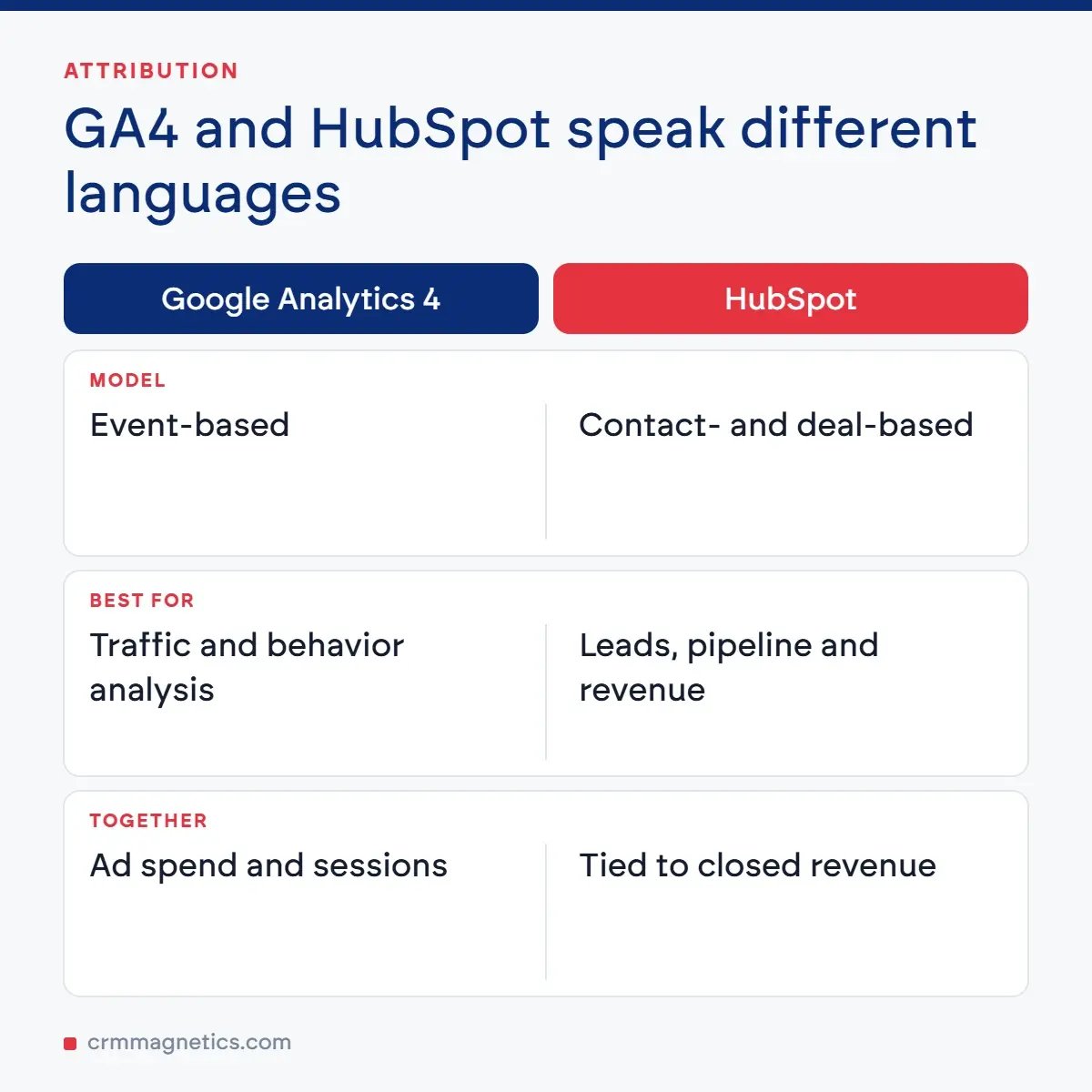
Many marketers struggle because these two tools speak different languages:
- Google Analytics 4 (GA4) is Event-Centric. It tracks anonymous behavior, sessions, and traffic patterns. It uses AI-driven Data-Driven Attribution (DDA) to assign credit.
- HubSpot is People-Centric. It tracks identified contacts, deals, and revenue. It uses Rule-Based Attribution (Linear, U-Shaped, etc.).
The Disconnect: You see 5,000 sessions in GA4 but only 2,000 contacts in HubSpot. Or GA4 claims Organic Search drove $50k in revenue, while HubSpot says it was Email.
How to Bridge the Gap (The "GA4 Attribution HubSpot" Playbook)
To reduce CAC, you need to stop optimizing for clicks (GA4’s view) and start optimizing for revenue (HubSpot’s view). Here is the 2026 playbook for integrating them:
1. The "Hidden Field" Strategy
You must pass the source data into the CRM at the moment of capture.
- Action: On every HubSpot form, include hidden fields for utm_source, utm_medium, utm_campaign, and gclid (Google Click ID).
- Result: When a lead is created in HubSpot, it carries its digital DNA with it. You know exactly which ad or keyword generated that specific person.
2. Sending Revenue Back to GA4 (Offline Conversions)
This is the "closed loop." When a deal moves to "Closed-Won" in HubSpot, that data shouldn't stay there.
- Action: Use the native HubSpot-to-GA4 integration (or tools like Ruler Analytics/Zapier) to send that "Closed-Won" event back to GA4 as a conversion event with a monetary value.
- Why this lowers CAC: When GA4 sees the actual revenue, it updates its Data-Driven Attribution model. It realizes that while "Campaign A" brought in cheap leads, "Campaign B" brought in the paying customers. You can then cut budget from Campaign A and double down on B.
3. Choosing the Right Attribution Model
In 2026, relying on "Last Click" is financial suicide. It overvalues bottom-of-funnel retargeting and undervalues the content that built the trust.
- In GA4: Stick to Data-Driven Attribution. It uses machine learning to analyze every touchpoint and assign fractional credit. It’s opaque, but it’s generally the most accurate reflection of influence.
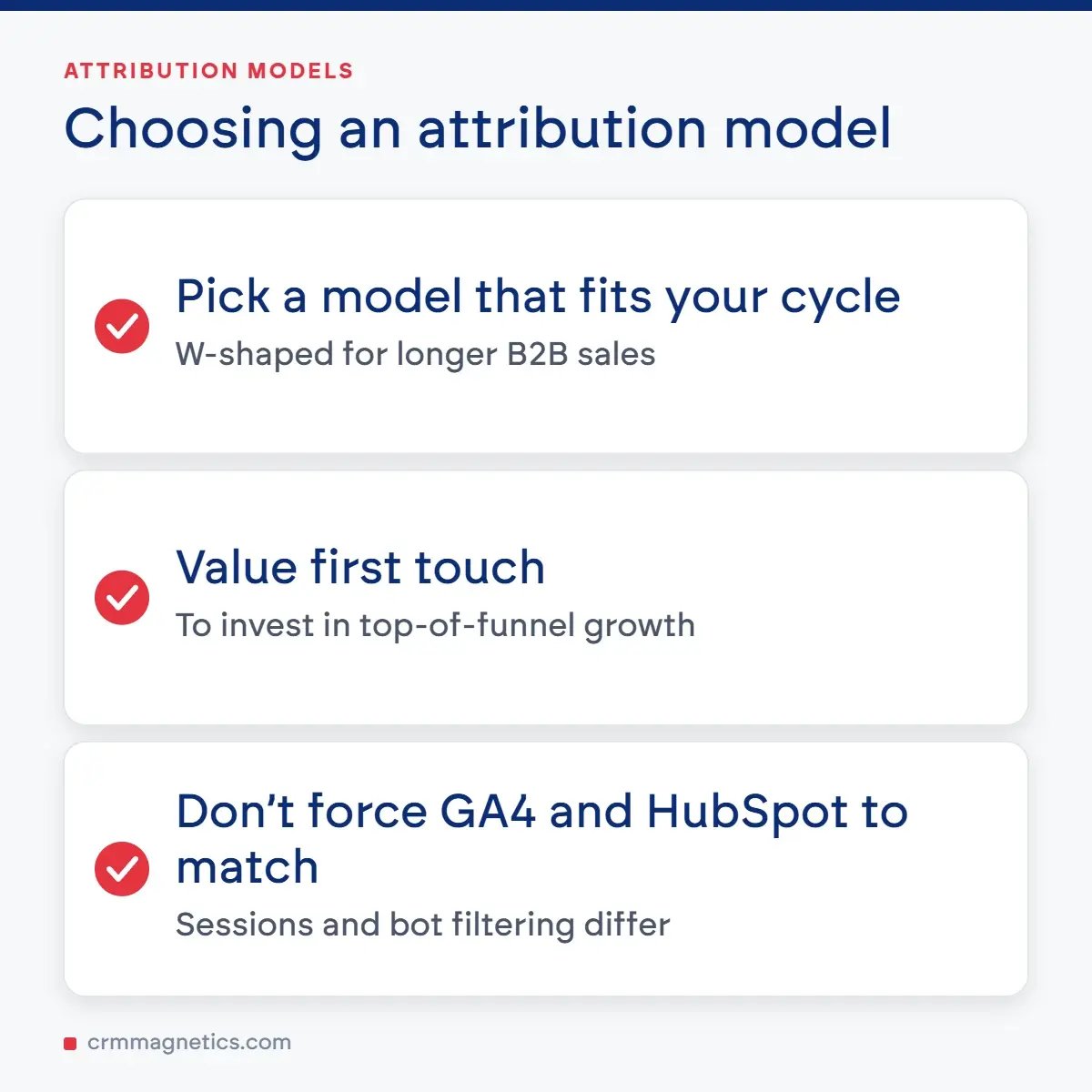
- In HubSpot: Use U-Shaped Attribution (40% to first touch, 40% to lead creation, 20% to the middle) or W-Shaped for longer B2B sales cycles. This highlights the channels that start the journey (First Touch), allowing you to invest in top-of-funnel growth efficiently.
Pro Tip: Don't try to make GA4 and HubSpot numbers match perfectly. They never will due to different session definitions and bot filtering. Instead, use GA4 for Traffic & Behavior Analysis and HubSpot for Revenue & Pipeline Analysis.
Part 3: Conversion Fixes – Squeezing More from Existing Traffic
If you can’t lower the cost of traffic (and you likely can’t, given platform inflation), you must increase the value of that traffic. Improving your conversion rate from 1% to 2% effectively halves your CAC.
1. Funnel Optimization & Friction Removal
In 2026, users have zero patience.
- Simplify Forms: Every extra field increases drop-off. Use data enrichment tools (like Clearbit or ZoomInfo) to auto-fill company data so you only need to ask for an email.
- Speed is a Feature: Ensure landing pages load in under 2 seconds. Core Web Vitals are a ranking factor and a conversion factor.
2. Conversational Commerce (The "WhatsApp" Factor)
For many markets, especially mobile-first regions like India and parts of LATAM/APAC, the website is becoming secondary to the chat app.
- Strategy: Instead of driving ad traffic to a landing page, drive it to a Click-to-WhatsApp or Click-to-Messenger conversation.
- Why: The "drop-off" rate on a chat conversation is significantly lower than a landing page bounce rate. You capture the lead immediately.
- Automation: Use AI chatbots to qualify these leads instantly, 24/7. If a user asks about pricing, the bot answers and books a meeting. This reduces the "speed to lead" gap, drastically improving conversion rates.
3. Hyper-Personalization
Generic landing pages are CAC killers.
- Dynamic Text Replacement: If a user clicks an ad for "CRM for Real Estate," the landing page headline should read "The Best CRM for Real Estate," not just "The Best CRM."
- Behavioral Triggers: If a user visits your pricing page and leaves, trigger an email (via HubSpot) 30 minutes later with a case study or a discount code. This "retention-style" tactic applied to acquisition can save lost leads.
Part 4: Retention – The Hidden CAC Reducer
We often think of CAC as purely an acquisition metric, but Retention is the new Acquisition.
The LTV:CAC Ratio
A healthy business in 2026 aims for an LTV:CAC ratio of 3:1 or 4:1.
- If your CAC is $100 and your LTV is $100, you are burning cash.
- If you increase Retention (LTV) to $300, that $100 CAC becomes sustainable.
Churn Reduction as a Growth Lever
High churn forces you to re-acquire customers constantly, keeping your blended CAC high.
- Onboarding: The first 90 days are critical. Use automated HubSpot workflows to guide new users to their "Aha!" moment.
- Referral Loops: Happy customers are your cheapest acquisition channel. A structured referral program (e.g., "Give $50, Get $50") can acquire new customers at a fraction of the cost of Facebook Ads.
Conclusion: The 2026 Growth Mindset
Reducing CAC in 2026 isn't about finding a "hack" or a secret ad network. It is about operational excellence.
It requires a shift from:
- Third-party cookies -> First-party data & Server-side tracking.
- Last-click attribution -> Unified GA4 + HubSpot Closed-Loop Reporting.
- Generic landing pages -> Personalized, conversational experiences.
By building a robust data infrastructure that links your ad spend (GA4) to your revenue (HubSpot), you stop flying blind. You can ruthlessly cut the 50% of your budget that isn't working and double down on the 50% that is. That is how you survive—and thrive—in the high-cost environment of 2026.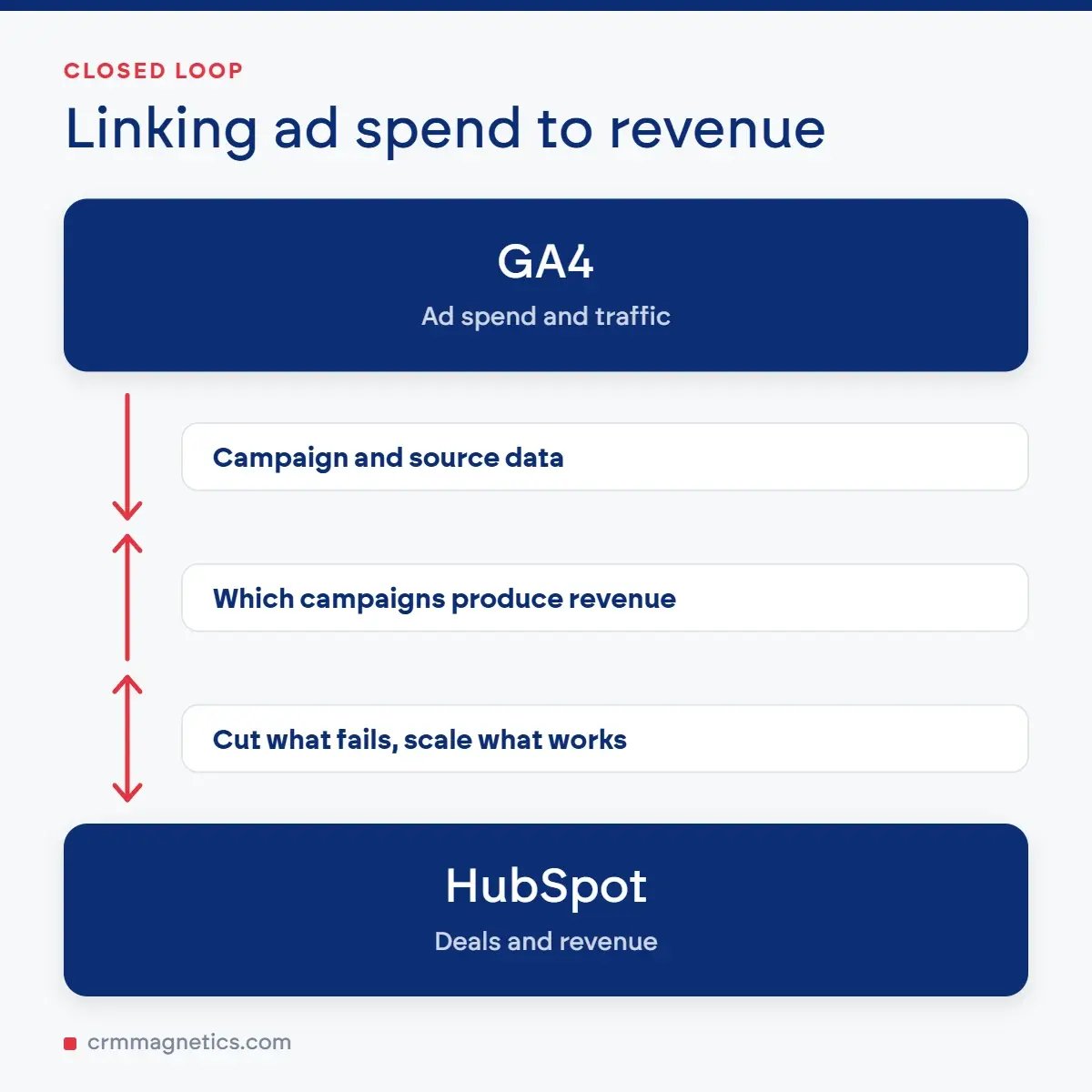
Summary Table (Tracking → Attribution → Conversion → Retention)
|
Section |
Goal (How it reduces CAC) |
Core Problem in 2026 |
What to Implement (Actions) |
Key Tools/Concepts |
KPI to Track |
|
1) Tracking (First-Party + Server-Side) |
Recover lost signal, improve optimization quality, reduce wasted spend |
Cookie loss, ad blockers, privacy browsers reduce pixel accuracy |
Move key events server-side; send clean conversion signals to ad platforms; prioritize value-based events |
Server-side tracking, First-party data, Meta CAPI, Google Enhanced Conversions |
Match rate, event deduplication %, conversion signal coverage, CPA/CAC by channel |
|
Clean Data (“Qualified Value”) |
Stop paying for low-quality volume |
Optimizing for generic “Lead” floods CRM with junk |
Define qualified milestones; pass values (not just counts) back to platforms |
Value-based optimization, conversion hierarchy |
Lead-to-MQL %, MQL-to-SQL %, CAC per qualified stage, revenue per lead |
|
2) Attribution (Closed-Loop Reporting) |
Shift budget from cheap leads to paying customers |
GA4 and HubSpot disagree; teams optimize different “truths” |
Connect ad/UTM identity → CRM contact → closed-won revenue → analytics |
Closed-loop reporting, identity stitching |
CAC by campaign (revenue-based), pipeline per source, payback period |
|
GA4 + HubSpot Bridge #1: Hidden Fields |
Preserve source-of-truth at capture |
Source data is lost when user becomes a CRM contact |
Add hidden fields on every form for UTMs and click IDs |
utm_source, utm_medium, utm_campaign, gclid |
% contacts with UTMs, % contacts with click IDs, form completion rate |
|
GA4 + HubSpot Bridge #2: Offline Conversions |
Train attribution and bidding on revenue |
GA4 optimizes on proxy events without revenue feedback |
Send “Closed-Won” (with value) back into GA4 as a conversion |
HubSpot→GA4 integration, Zapier/Ruler |
Revenue attributed (DDA), ROAS/POAS, CAC trend after feedback loop |
|
Attribution Models |
Avoid over-crediting retargeting / last-click |
Last-click hides TOFU impact and trust-building content |
Use DDA in GA4; use U-shaped/W-shaped in HubSpot depending on cycle length |
GA4 DDA, HubSpot rule-based models |
Assisted conversions, pipeline influence by TOFU channels |
|
3) Conversion Fixes (CRO) |
Increase conversion rate → lower CAC without lowering traffic costs |
Platform inflation makes clicks expensive |
Remove friction, speed up pages, improve relevance |
Funnel optimization, Core Web Vitals |
CVR, drop-off by step, time-to-interactive, CPL → CAC |
|
Forms + Speed |
Reduce abandonment, increase lead volume quality |
Users have low patience; long forms hurt completion |
Reduce fields; use enrichment to capture company info |
Clearbit, ZoomInfo, enrichment |
Form completion %, lead quality score, page load time |
|
Conversational Commerce (WhatsApp/Messenger) |
Capture leads faster, reduce drop-off |
Mobile-first markets prefer chat over sites |
Click-to-WhatsApp/Messenger flows; instant qualification |
Chat automation, speed-to-lead |
Chat-to-lead %, speed-to-lead, meeting booked rate, CAC from chat |
|
Hyper-Personalization |
Raise relevance → lift CVR → lower CAC |
Generic pages don’t match intent |
Dynamic text replacement; behavior-triggered follow-ups |
DTR, behavioral email triggers (HubSpot) |
Landing page CVR, bounce rate, return-to-site rate, influenced revenue |
|
4) Retention (LTV lever) |
Improve LTV:CAC; make CAC sustainable |
High churn forces re-acquisition |
Strong onboarding; referral program loops |
Onboarding workflows, referrals |
LTV:CAC ratio, churn %, activation rate, referral CAC |
FAQ
1) What’s the biggest driver of high CAC in 2026?
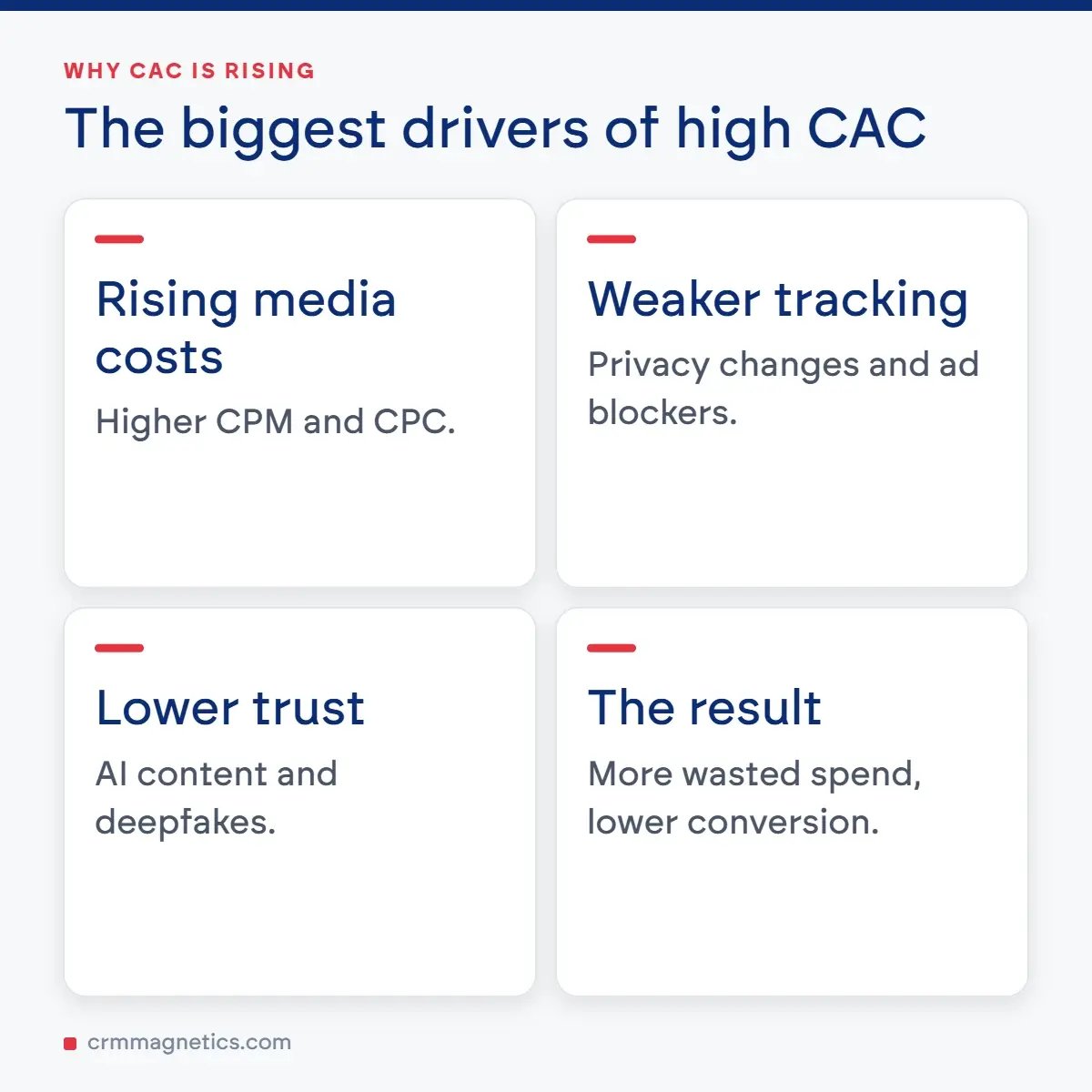
Rising platform CPM/CPC (inflation), degraded tracking signal (privacy + ad blockers), and lower trust (AI content/deepfakes) combine to increase wasted spend and lower conversion efficiency.
2) Why doesn’t “cutting ad spend” reliably reduce CAC?
Cutting spend often reduces volume but doesn’t fix inefficiency. CAC improves when you increase targeting precision and conversion rate—so you buy better customers, not just fewer clicks.
3) What does “server-side tracking” change vs client-side pixels?
Client-side pixels fire in the browser and can be blocked or stripped. Server-side tracking sends events from your server, improving signal reliability and helping platforms learn from cleaner conversion data.
4) What are “value-based signals” and why do they matter?
Instead of optimizing for “Lead” events, you optimize for events tied to business value (e.g., qualified lead, SQL, closed-won revenue). This trains bidding and attribution toward outcomes that actually reduce CAC.
5) Why do GA4 and HubSpot attribution numbers never match?
GA4 is session/event-centric and often modeled (DDA). HubSpot is person/deal-centric and rule-based. They also differ in identity resolution, session definitions, and bot filtering. Use each for what it’s best at.
6) What is closed-loop reporting in plain terms?
It’s connecting marketing touchpoints → CRM contacts → pipeline/deals → revenue, then feeding revenue back into analytics/attribution so you can optimize for paying customers, not clicks.
7) What is the “Hidden Field” strategy and what should I capture?
Add hidden fields on all HubSpot forms to capture acquisition parameters at the moment of conversion:
- utm_source, utm_medium, utm_campaign
- gclid (and optionally other click IDs depending on channels)
8) What are “offline conversions” and how do they reduce CAC?
Offline conversions are downstream events (like Closed-Won) that occur in the CRM, not on the website. Sending them back to GA4 improves attribution and helps you cut spend on campaigns that generate cheap leads but poor revenue.
9) Which attribution model should I use in GA4 and HubSpot?
- GA4: Data-Driven Attribution (best reflection of multi-touch influence, though it’s a “black box”).
- HubSpot: U-shaped for many funnels; W-shaped for longer B2B cycles where opportunity creation is a key milestone.
10) What’s the fastest CRO win to reduce CAC without changing ad budgets?
Improve conversion rate by reducing friction:
- Fewer form fields (use enrichment instead)
- Faster landing pages (under ~2 seconds)
- Message/offer match via personalization
11) Why does conversational commerce (WhatsApp/Messenger) help CAC?
Chat reduces drop-off versus landing pages, captures intent immediately, and enables real-time qualification/booking—improving conversion rate and shortening speed-to-lead.
12) How does retention affect CAC if CAC is an acquisition metric?
CAC becomes “sustainable” or “unsustainable” based on LTV. Higher retention increases LTV, improving the LTV:CAC ratio and reducing the pressure to constantly re-acquire churned customers.
13) What LTV:CAC ratio should a healthy business aim for in 2026?
Common targets are 3:1 to 4:1. Below that, you risk margin compression and cash burn unless you have strategic reasons (e.g., land-and-expand with proven payback).
14) What’s a practical first step if I’m starting from scratch?
Start with data integrity:
- Add hidden UTM/click ID fields to every form
- Define “qualified” conversion milestones
- Set up Closed-Won revenue feedback into GA4
Then run CAC analysis by campaign based on revenue, not leads.
Leave your thought here
Your email address will not be published. Required fields are marked *