


- April 30 2026
- Nikias Kray
Introduction
CRM marketing is the discipline of using customer relationship management (CRM) data to plan, execute, and optimize marketing across the entire customer lifecycle—acquisition, onboarding, engagement, retention, and expansion. Unlike channel-first marketing (where tactics start with email, ads, or social), crm marketing starts with the customer record: who they are, what they have done, what they need next, and how your brand can deliver value at the right moment.
In practice, crm marketing combines three ingredients: (1) a reliable database of contacts and accounts, (2) segmentation and personalization logic, and (3) orchestration across channels such as email, SMS, in-app, paid media audiences, and sales touchpoints. The result is marketing that is measurable, repeatable, and incrementally improves over time through experimentation.
This article provides a structured roadmap: definitions, core components, key metrics, a table of common programs and the data they require, implementation steps, and an FAQ at the end. The goal is to help you turn CRM data into revenue without turning your CRM into a chaotic dumping ground.
What is CRM marketing?
At its core, crm marketing is lifecycle marketing powered by CRM and customer data. It connects messages to context—purchase history, product usage, support interactions, pipeline stage, and preferences—so outreach feels relevant rather than repetitive.
A simple test: if your campaigns would work the same way without customer-level data, you’re not really doing crm marketing. True crm marketing uses identity (a known user or account), history (events and attributes), and intent signals (recent behavior) to decide: what to say, when to say it, and which channel to use.
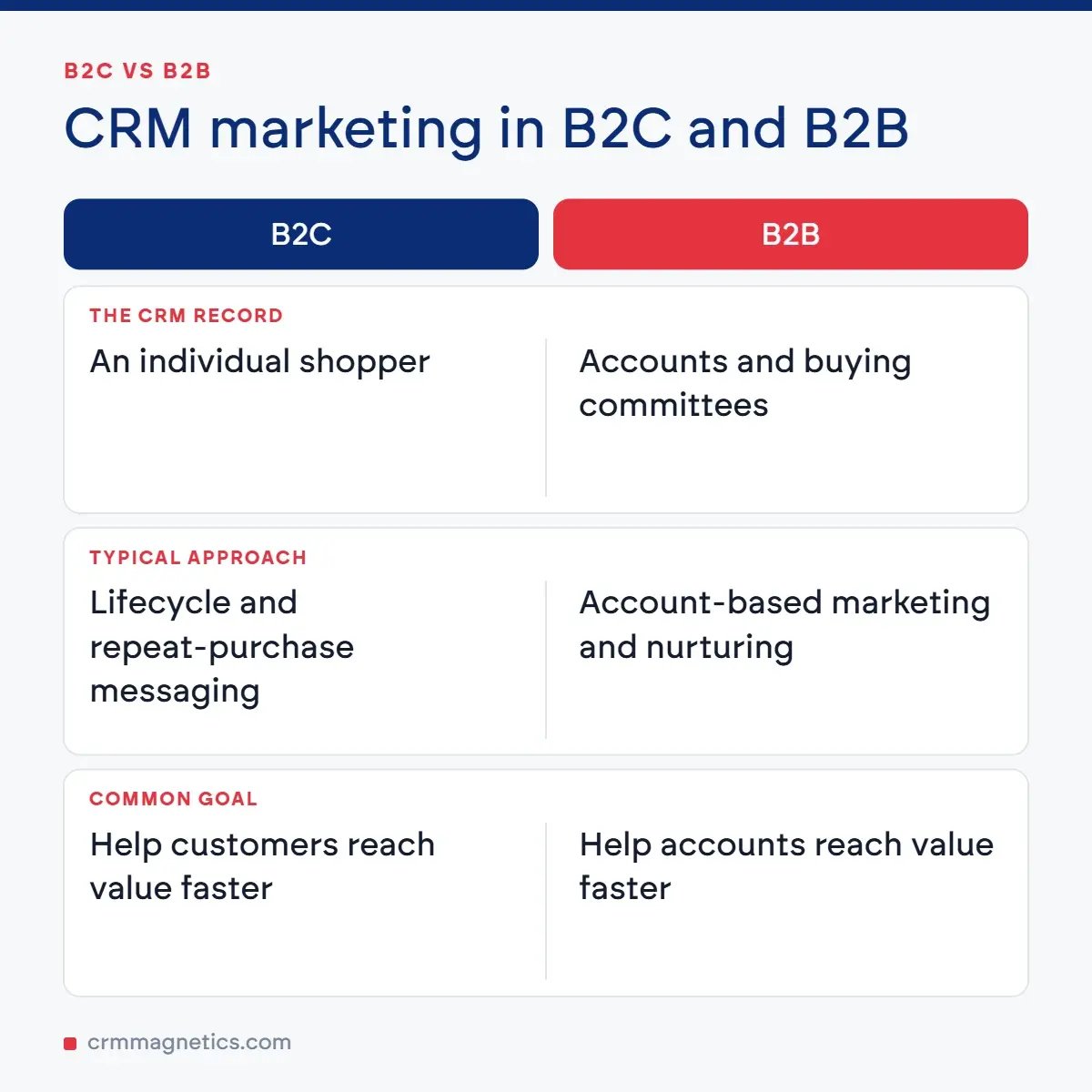
For B2C, the CRM record might be tied to an individual shopper. For B2B, it often centers on accounts and buying committees, where the CRM must support account-based marketing (ABM) as well as lead nurturing. In both cases, the strongest programs focus on customer outcomes: helping people reach value faster, avoid friction, and discover the next best product or plan.
The five building blocks of effective CRM marketing
Successful crm marketing depends less on flashy automation and more on a dependable foundation. Five components matter most:
1) Data model and hygiene. Define what a contact, lead, opportunity, account, and customer mean in your business. Standardize naming conventions, required fields, deduplication rules, and ownership. CRM marketing breaks down quickly when you can’t trust basic fields like lifecycle stage, country, or product plan.
2) Identity and consent. Unify identities across systems (website, product, POS, support, billing). Track consent and preferences by region and channel. Compliance isn’t just legal protection; it improves deliverability and trust, which improves performance.
3) Segmentation and audiences. Build reusable segments that map to lifecycle questions: Who is new? Who is stuck? Who is expanding? Who is at risk? Avoid segment sprawl by creating a small ‘core library’ of definitions that sales, marketing, and support share.
4) Journey orchestration. Automations should behave like systems: triggers, rules, frequency caps, suppression logic, and fallbacks. A journey isn’t ‘send three emails’; it’s ‘help the customer complete a milestone’ with the minimum effective set of touches.
5) Measurement and experimentation. Establish baseline metrics and run controlled tests. Track incremental lift, not just clicks. The best crm marketing teams treat every program as a product: they instrument it, ship improvements, and retire what doesn’t work.
Segmentation and personalization
Segmentation frameworks that scale
Most teams start with basic segments (new leads, active customers, churned users). That’s fine, but it’s not enough to scale. A practical approach is to segment along three axes: (a) lifecycle stage, (b) value, and (c) intent.
Lifecycle stage answers: where is the customer in their relationship with you? Examples: subscriber, trial, onboarded, activated, repeat buyer, expansion-ready.
Value answers: how important is this customer economically? Use proxies like revenue (MRR, ARPU), margin, cohort LTV, or account size.
Intent answers: what are they trying to do right now? Signals include site visits to pricing, feature usage spikes, quote requests, support tickets, or abandoning a key workflow.
When you combine these axes, you get segments that are both meaningful and actionable, such as: ‘Mid-value customers who are activated but haven’t used Feature X in 14 days’ or ‘Enterprise accounts with high intent (pricing page + demo request) but stalled opportunity stage.’
Personalization without creepy marketing
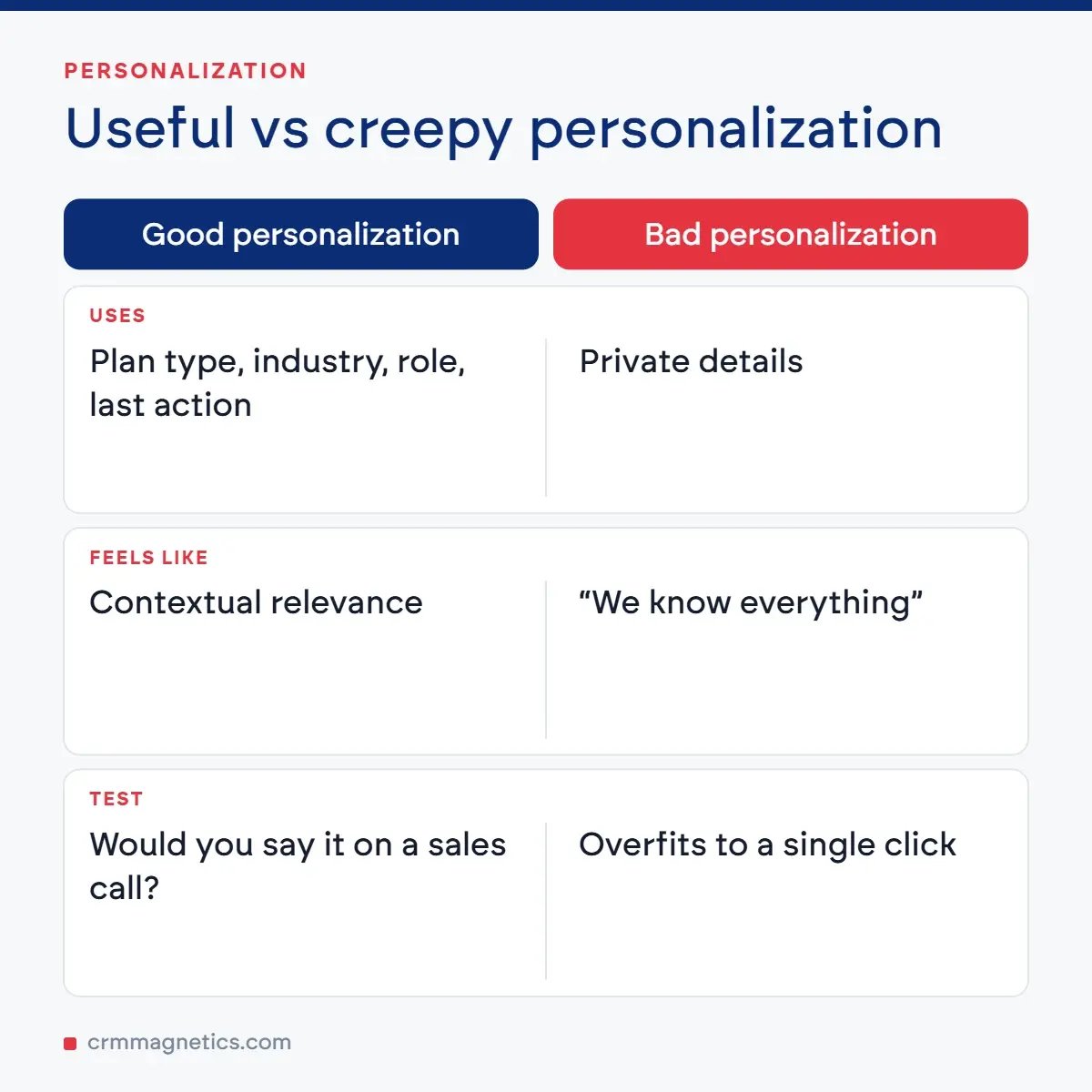
Personalization in crm marketing should be useful, not invasive. Aim for ‘contextual relevance’ rather than ‘we know everything.’ Good personalization uses: plan type, industry, role, last action, and a clear next step. Bad personalization recites private details or overfits to a single click. If you wouldn’t say it in a sales call, don’t put it in an automated email.
Metrics that matter
CRM marketing is only as strong as its measurement. Avoid vanity metrics and focus on lifecycle outcomes. Key metric categories include:
- Data quality metrics: % records with required fields, duplicate rate, bounce rate, consent coverage.
- Engagement metrics: open rate (directional), click-to-open rate, reply rate, in-app engagement.
- Conversion metrics: trial-to-paid, lead-to-opportunity, opportunity-to-close, first-to-second purchase.
- Retention metrics: churn rate, renewal rate, net revenue retention (NRR), repeat purchase rate.
- Experience metrics: time-to-value, onboarding completion, ticket volume, CSAT/NPS where applicable.
The most important habit is to define a ‘primary KPI’ per journey and keep everything else diagnostic. For example, onboarding email performance should be judged by activation rate and time-to-value, not just email clicks. A win is when customers succeed faster—even if clicks decrease because the message is clearer and requires fewer steps.
Table: CRM marketing programs, required data, and KPIs
Common CRM marketing programs (with the data they require)
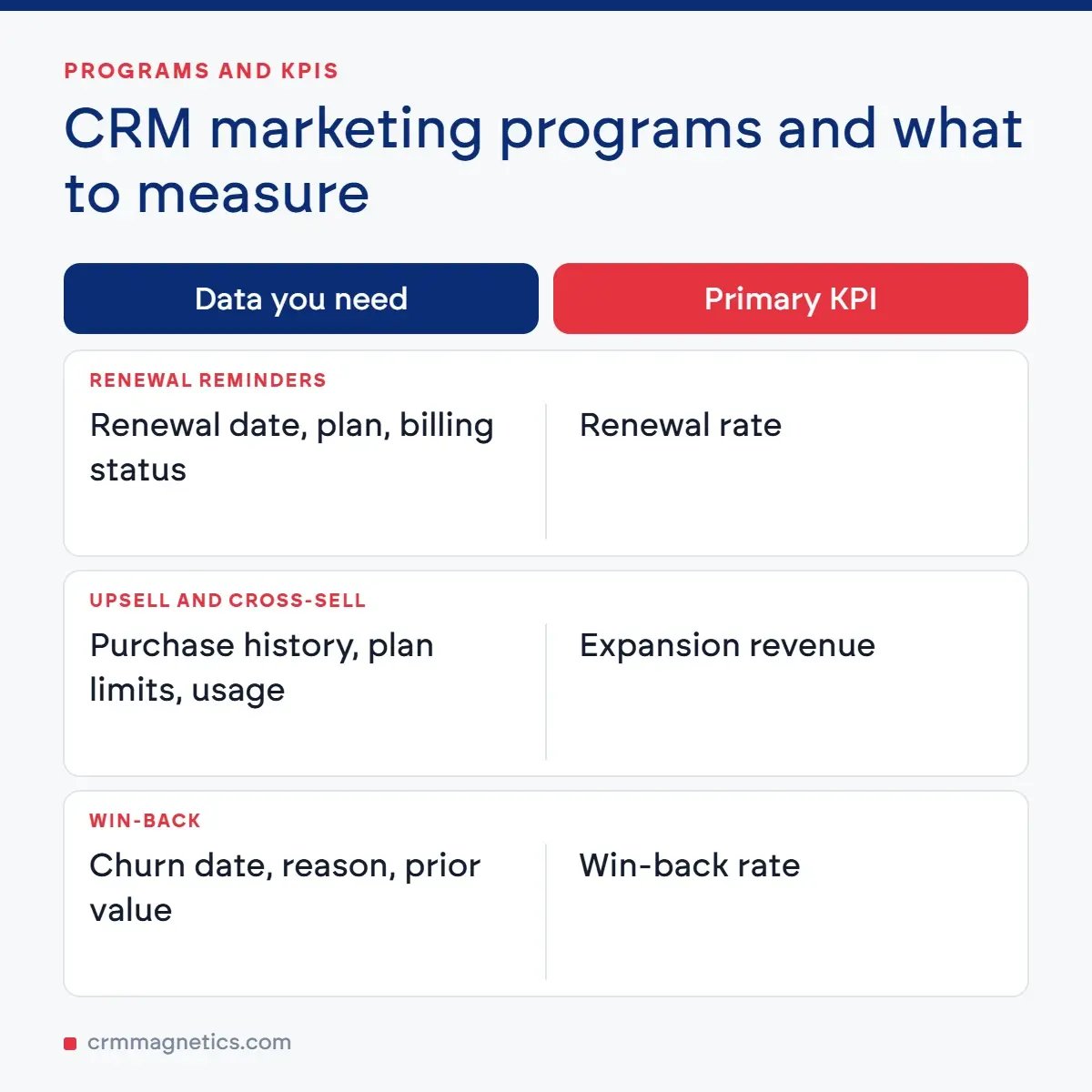
The table below summarizes high-impact crm marketing programs, the minimum data needed, and what to measure. Use it to prioritize: start with programs that match your current data maturity and business model, then expand as your instrumentation improves.
|
Program |
Best for |
Minimum data needed |
Primary KPI |
|
Welcome / onboarding |
New leads or new customers |
Signup date, lifecycle stage, key activation event |
Activation rate / time-to-value |
|
Lead nurture |
Long sales cycles |
Industry/role, content engagement, stage |
Lead-to-opportunity conversion |
|
Abandoned cart / quote follow-up |
Ecommerce or proposals |
Cart/quote event, product, timestamp |
Recovered revenue / conversion rate |
|
Reactivation |
Dormant users |
Last active date, usage events, preferences |
Return to active / repeat purchase |
|
Renewal reminders |
Subscriptions |
Renewal date, plan, billing status |
Renewal rate |
|
Upsell / cross-sell |
Existing customers |
Purchase history, plan limits, feature usage |
Expansion revenue / attach rate |
|
Customer education |
Complex products |
Milestone completion, feature usage gaps |
Feature adoption / reduced tickets |
|
Win-back |
Churned customers |
Churn date, churn reason, prior value |
Win-back rate / reactivated MRR |
Implementation roadmap
Implementation roadmap (from zero to compounding gains)
A practical rollout for crm marketing typically looks like this:
Step 1: Define lifecycle stages and ownership. Write down your stage definitions and make them visible. Decide who owns each stage: marketing, sales, customer success, or shared.
Step 2: Audit your data. Identify the 10–20 fields and events you truly need (not 200). Fix the biggest sources of uncertainty: duplicates, missing emails, inconsistent country/state, and unclear opt-in.
Step 3: Launch ‘must-have’ journeys. The fastest ROI usually comes from: welcome/onboarding, abandoned cart or lead follow-up, renewal reminders, and reactivation. Keep them short, helpful, and frequency-capped.
Step 4: Add segmentation and suppression rules. Prevent over-messaging. Build global rules: no more than X messages per week; suppress customers with open support tickets; exclude people in sales negotiation from generic promos; pause journeys after conversion.
Step 5: Close the loop with sales and support. Share journey logic and triggers. In B2B, push the right signals to sales (high intent, risk flags) and log key touches. In B2C, coordinate with support to avoid contradictory messaging.
Step 6: Experiment and iterate. Test one variable at a time: offer, timing, channel mix, or audience definition. Track lift using holdouts where possible. Over time, crm marketing becomes a compounding system: better data enables better journeys, which generates better signals, which improves data again.
Common pitfalls
Common pitfalls (and how to avoid them)
Even well-funded teams can struggle with crm marketing when complexity grows faster than governance. Watch for these pitfalls:
- Over-automation: too many journeys competing for attention. Fix with a journey catalog, prioritization, and global caps.
- Field sprawl: hundreds of rarely-used fields. Fix with a ‘golden fields’ list and archival policy.
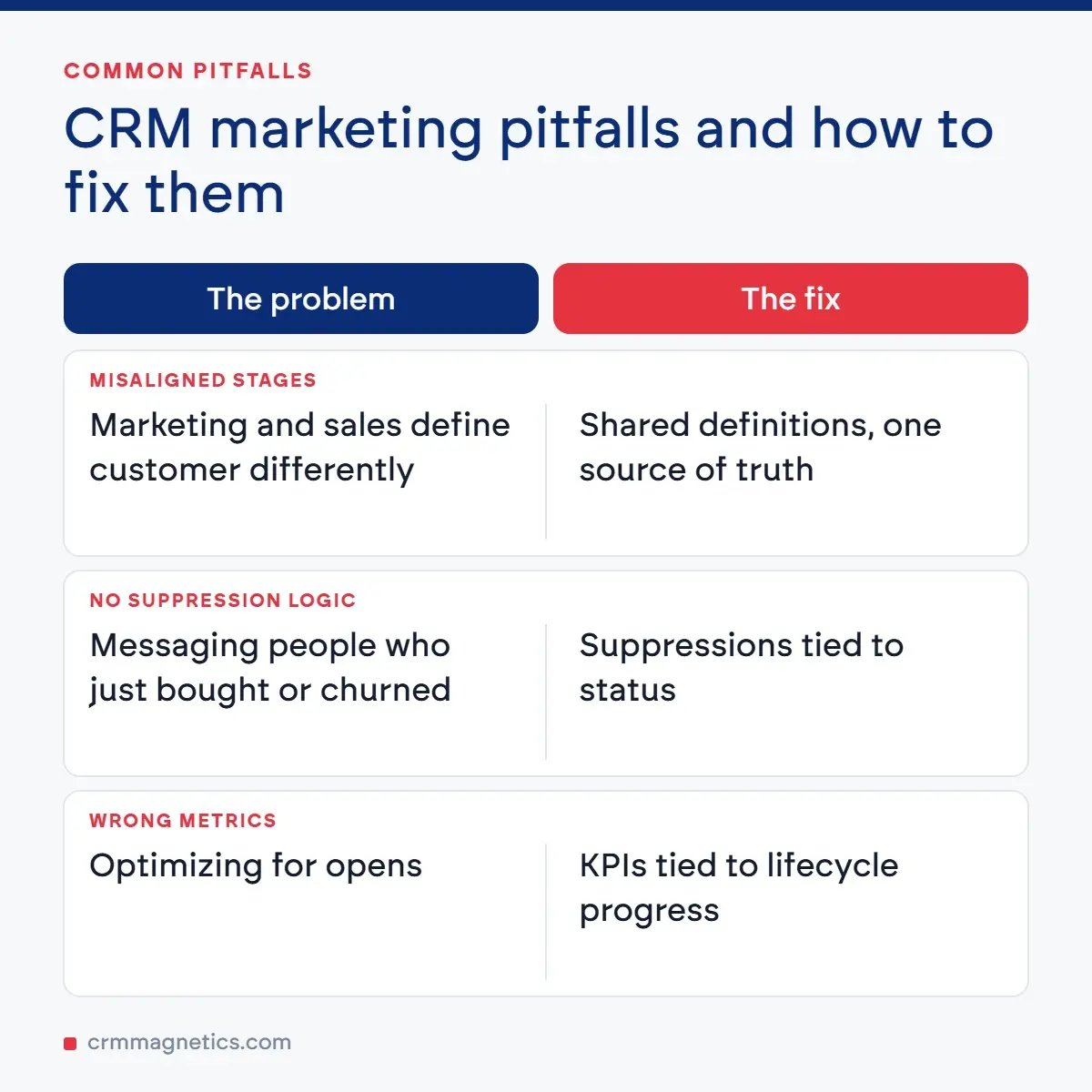
- Misaligned stages: marketing calls someone a customer while sales calls them a lead. Fix with shared definitions and a single source of truth.
- No suppression logic: messaging customers who just bought, churned, or are in crisis. Fix with suppressions tied to status and support signals.
- Measuring the wrong thing: optimizing for opens instead of outcomes. Fix with primary KPIs tied to lifecycle progress.
Advanced tactics
Advanced tactics (when the basics are stable)
Once your foundation is working, consider advanced crm marketing tactics:
- Predictive scoring: propensity to buy, churn risk, product affinity. Use as a ranking signal, not a single source of truth.
- Next-best-action personalization: recommend the most helpful next step based on behavior patterns and role.
- Multi-channel orchestration: coordinate email with in-app prompts, sales tasks, and paid retargeting audiences.
- Post-purchase education: reduce returns and increase satisfaction with timely setup tips and usage coaching.
- Win-back with meaning: tailor win-back offers to the reason for churn (price, fit, complexity) and provide a clear path to value.
Conclusion
CRM marketing works because it treats marketing as a relationship, not a blast. When your CRM data is trustworthy and your journeys are designed to help customers succeed, you get higher conversion, stronger retention, and clearer attribution. Start with a small set of lifecycle programs, measure outcomes, and iterate. Over time, crm marketing becomes one of the highest-leverage growth engines in your organization.
FAQ
Q1: What does ‘crm marketing’ mean in one sentence?CRM marketing uses CRM and customer data to deliver relevant, lifecycle-based messaging that improves conversion, retention, and expansion.
Q2: Is CRM marketing only email marketing?No. Email is common, but crm marketing also uses SMS, in-app messaging, paid audiences, direct mail, and coordinated sales/customer-success touches.
Q3: What’s the first CRM marketing automation I should build?Typically a welcome/onboarding journey (for trials or new customers) or a fast lead follow-up sequence. Choose the one closest to revenue and easiest to measure.
Q4: How do I avoid spamming customers with too many journeys?Implement global frequency caps, suppression rules (e.g., recent purchase, open support case), and a single journey catalog with clear priorities.
Q5: Which KPI matters most for CRM marketing?It depends on the journey. Pick one primary KPI that reflects lifecycle progress (activation, purchase, renewal, expansion) and use engagement metrics only as diagnostics.
Q6: Do I need a CDP to do CRM marketing?Not necessarily. Many teams start with a CRM plus basic event tracking and integrations. A CDP helps when identity resolution, real-time events, and multi-system data become limiting factors.
Leave your thought here
Your email address will not be published. Required fields are marked *